
Introduction
China is home to 56 officially recognized ethnic groups, and South China - Guangdong, Guangxi, Hainan, Hong Kong, and Macau - is where many of their most vibrant traditions come alive. But this is not a museum of static artifacts. This is a living tapestry of song, dance, costume, ritual, and craftsmanship passed down through generations.
For the traveler seeking more than sightseeing, South China offers an immersive journey into the region's rich ethnological heritage. From the "living minority museum" of Guangxi's remote mountains to the thatched boat-shaped houses of Hainan's Li people, this route invites you not just to observe, but to participate, to learn ancient crafts with your own hands, to share meals in century-old wooden houses, and to dance alongside communities who have preserved their traditions for millennia.
Guangdong: The Hidden World of the Yao
While most travelers associate Guangdong with skyscrapers and dim sum, the province's northern mountains harbor a remarkable cultural treasure: the Yao people of Ruyuan Yao Autonomous County. In 2025, Guangdong officially launched its first batch of "Lingnan Ethnic Characteristic Tourism Routes," with Ruyuan's "World Yao Village · Healing Sanctuary" route standing out as a flagship experience.
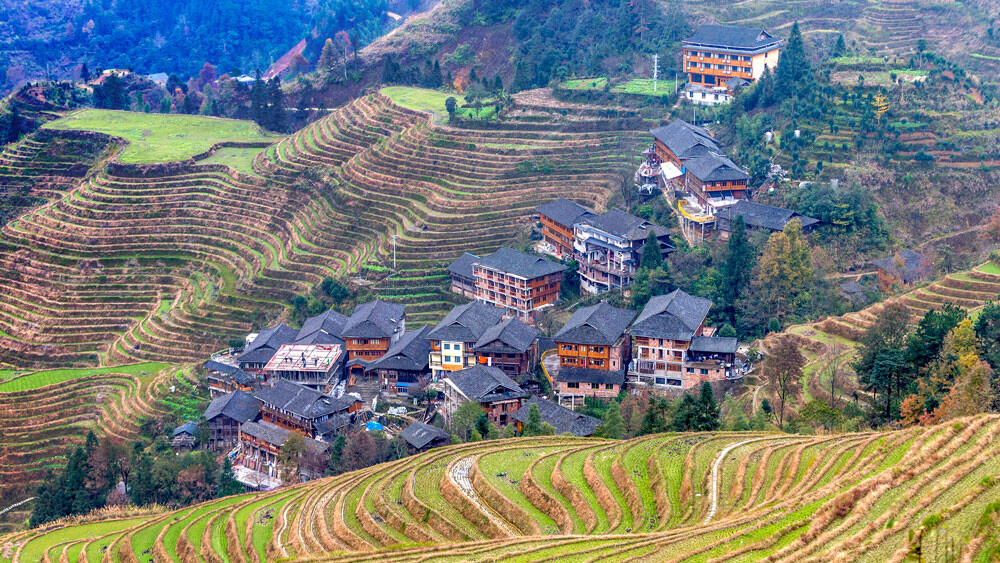
Walk inside a Yao ethnic village in south China's Ruyuan Yao Autonomous County
The route weaves through Nan Shui Lake Wetland Park, Ruyuan Intangible Heritage Living Museum, Ruyuan Ethnic Museum, Bibei Yao Village, Diaozitang Yao Ethnic Corridor, and Yunmen Mountain Eco-Cultural Tourism Area, eight carefully selected sites that showcase the region's "mountain, water, forest, Yao, Zen, and valley" elements.
The real magic happens in Bibei Yao Village, where visitors can witness Yao embroidery, an intangible cultural heritage with 26 national, provincial, and municipal-level protected items, including the Yao King Pan Festival, Yao embroidery, and Yao folk songs. Visitors can learn from master embroiderers who have practiced their craft for decades, their needles weaving patterns that have told Yao stories for centuries.
For a deeper immersion, the route offers "hot spring hotels + Yao medicinal herb steaming baths", "star-rated B&Bs + Yao embroidery design", and "agritourism complexes + Yao folk activities", blending culture, wellness, and hands-on participation. The region regularly hosts Yao song and dance performances, intangible heritage craft workshops, and Yao-style long-table banquets where visitors sit alongside local families.
Guangxi: The Heartland of Ethnic Diversity
Cheng Yang Eight Villages: Living Among the Dong
Cross into Guangxi, and you enter one of China's most ethnically diverse provinces. Here, the Cheng Yang Eight Villages in Sanjiang Dong Autonomous County offer perhaps the most immersive ethnic experience in all of South China. Designated as a national 5A-level tourist attraction in 2024, this is the largest concentration of Dong wooden architecture in China, home to over 2,000 stilted wooden houses, 13 drum towers, and 11 wind-and-rain bridges.
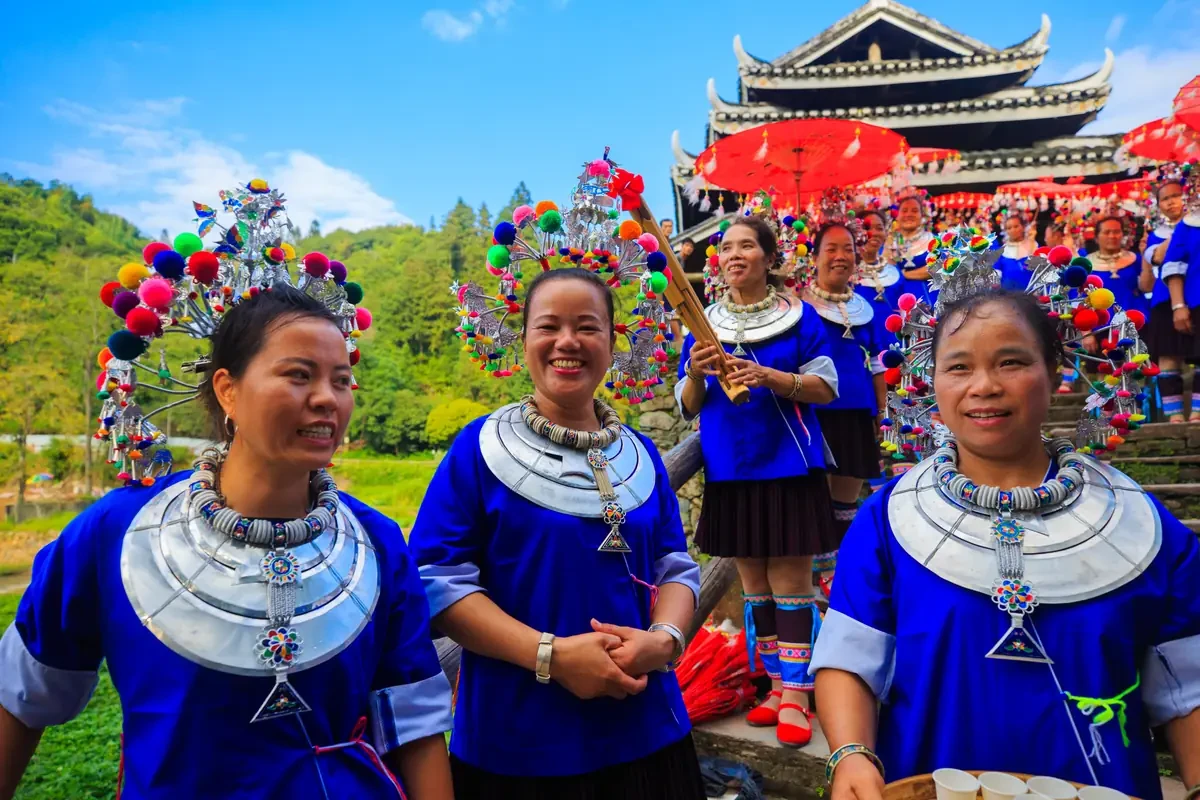
Dong women line the streets singing and offering toasts to welcome guests
The Dong people call this place home, and they welcome visitors not as tourists but as guests. Walk through the ancient villages, and you will hear the haunting sound of the lusheng (reed pipe) echoing from the welcome square, a traditional Dong greeting that has announced hospitality for centuries. Step inside a hundred-year-old wooden house and gather around the fire pit (火塘), the heart of Dong family life, where stories are shared, oil tea is brewed, and glutinous rice cakes are roasted over the flames.
The most profound experience here is the "One Day as a Dong Family" program, where visitors enter a century-old Dong residence to wear traditional Dong clothing, eat a Dong family meal, learn Dong songs, and truly live as a Dong person for a day. The village also features the China Dong Painting Museum, the largest collection of Dong folk art in the country, with over 500 works on display and dedicated painting workshops where visitors can try their hand at this distinctive art form.
Longji Terraces: Red Yao Traditions in the Misty Mountains
Further south, the Longji Rice Terraces in Longsheng County offer a different but equally compelling experience. Recognized as a Global Important Agricultural Heritage System and one of China's first National Study Tour Demonstration Bases, these ancient terraces are not just a landscape; they are a living classroom.
The terraces are home to the Red Yao people, known for their remarkable long hair tradition. The China Long Hair Science and Technology Museum focuses on Red Yao hair culture, recreating the traditional fermentation process of rice-washing water that the Yao have used for generations to maintain their famously long, healthy hair. Visitors can tour the production facilities, learn about traditional hair-care methods, and even participate in product development experiences.
During the annual "Sun-Clothes Festival" (晒衣节) in Dazhai Village, the terraces transform into a spectacular stage. Visitors can participate in mud fishing in the rice paddies, attend a Red Yao wedding banquet, and witness the breathtaking "Torch Light on the Terraces" ceremony, thousands of torches illuminating the mountainside in a mesmerizing display of light and tradition.
For a slower, more contemplative experience, the region offers tea culture study tours during the annual Longji Ancient Tea Festival, where visitors can harvest fresh tea leaves, make tea by hand, and learn about the history and craftsmanship of Longji tea.
Longlin: The "Living Minority Museum"
Perhaps the most extraordinary destination in Guangxi is Longlin Various Ethnicities Autonomous County in the province's northwest corner, praised by UNESCO as a "Living Minority Museum". Here, five ethnic groups, Miao, Zhuang, Yi, Gelao, and Han, have lived side by side for centuries, each preserving distinct traditions.
Longlin's festivals are a year-round celebration of ethnic diversity. In the first month of the lunar calendar, the Miao Jumping Pole Festival fills the mountains with the sound of the lusheng, as young men compete in bare-handed pole-climbing, a test of courage and skill that wins the admiration of onlookers. In spring, the Zhuang Song Festival echoes across the Nanpan River with improvised mountain songs that have been passed down for generations. In summer, the Yi Torch Festival lights up the night sky with thousands of torches forming a "fire dragon" that winds through the mountains. In autumn, the Gelao New Rice Festival offers thanks to nature through elaborate "tree-worshipping" ceremonies and harvest dances. And in winter, the Han Hot Pot Festival brings communities together around steaming bowls of broth, a tradition dating back to the Ming and Qing dynasties.
For visitors, Longlin offers the chance to stay in a Miao stilted house in Zhangjiazhai, often called the "Lijiang of Longlin", where you can drink oil tea, listen to Miao songs, and experience life as a "mountain dweller". You can also row dragon boats on the lake at Laren Joyful Water Town, pick and process tea at the 1,680-meter-high Sanchongyuan Tea Plantation, and taste local specialties like Longlin black zongzi, a "black peony" of glutinous rice infused with plant-ash water and stuffed with pork, mung beans, and chestnuts.
Hainan: The Li and Miao of the Tropical Island
For a completely different ethnic experience, head south to Hainan Island, home to the Li and Miao peoples. At the Binglanggu Li & Miao Cultural Tourism Zone (槟榔谷黎苗文化旅游区) in Baoting County, visitors step into a "living museum" of Hainan's indigenous cultures.
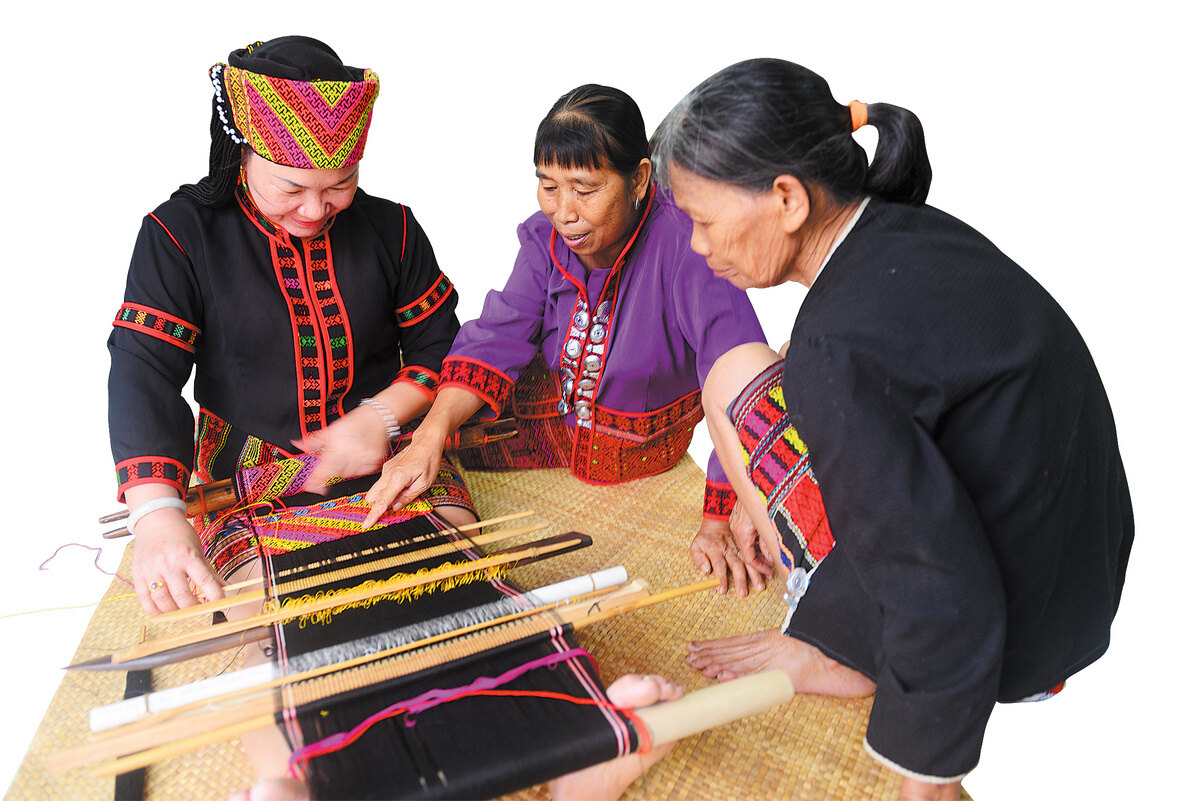
A Li Woman (left) teaches the other two local peers in Wuzhishan, Hainan province
Here, 80-year-old Li grandmothers demonstrate the ancient art of Li brocade weaving, a craft so intricate that only a handful of elders can still weave human figures and landscapes into their designs. Visitors can learn to weave alongside these masters, their fingers pushing wooden shuttles through cotton threads to create patterns that have told Li stories for centuries.
The park offers a remarkable range of hands-on experiences: traditional Li spinning, dyeing, weaving, and embroidery; rattan and bamboo weaving; fire-making by friction; primitive pottery; the Li "firewood dance" (打柴舞); and boat-shaped house construction, all taught by practitioners who learned these skills from their grandparents.
Beyond Binglanggu, the island offers other cultural gems. The Hainan Danjia Museum in Lingshui showcases the unique culture of the Dan people, "boat-dwellers" who have lived on the sea for generations, with multimedia exhibits that let visitors experience life on a floating fishing platform. And in Baicha Village in Dongfang City, visitors can walk among the well-preserved boat-shaped houses, the "living fossils" of Li stilted architecture.
Hong Kong: Intangible Heritage in a Modern Metropolis
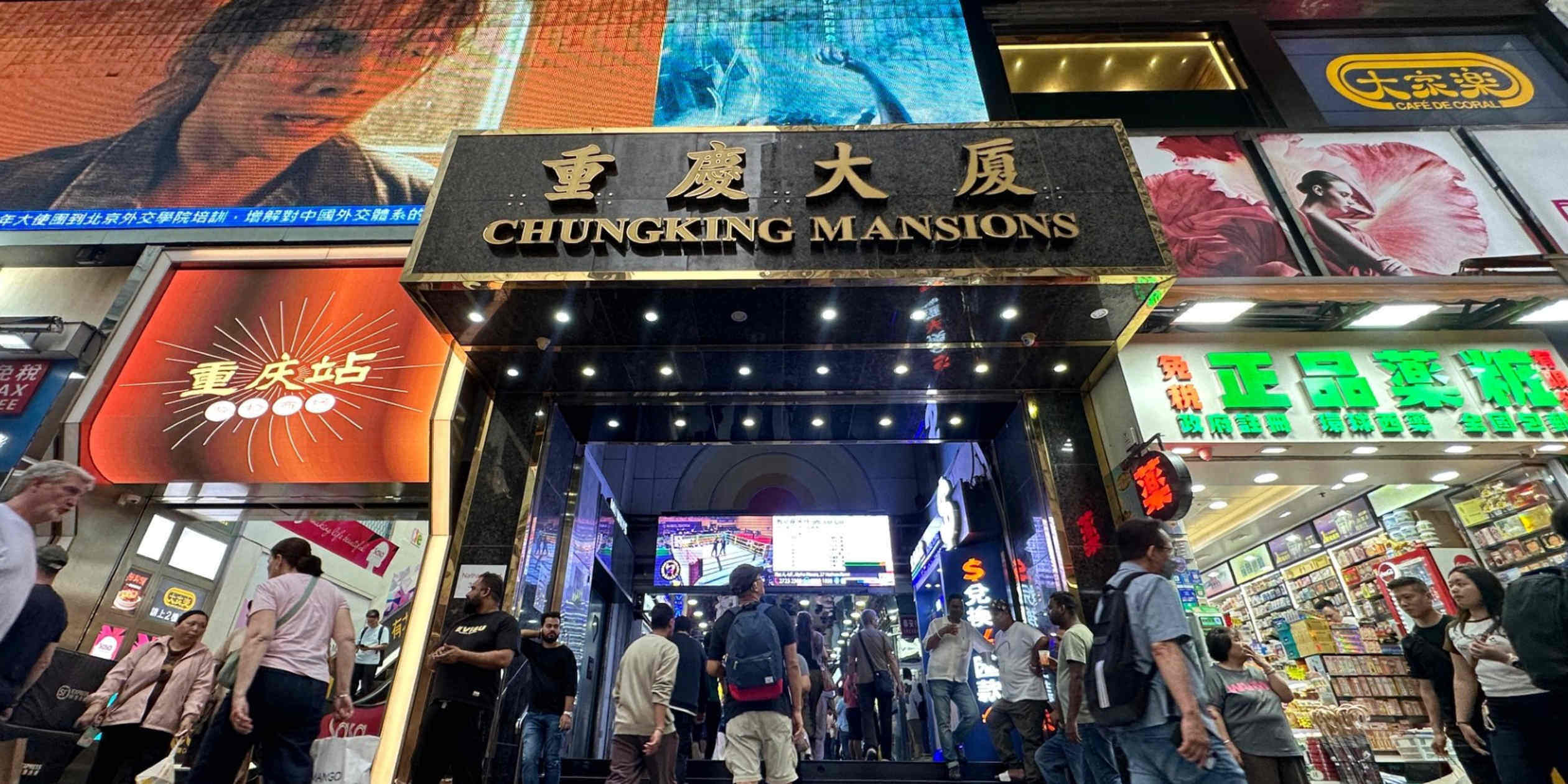
Hong Kong is not all skyscrapers. Beneath the neon lies a wealth of intangible cultural heritage, Cantonese traditions, and vibrant South Asian communities. A cultural tour of Chungking Mansions in Tsim Sha Tsui, called "the world's most globalized building" by National Geographic, introduces visitors to Indian, Pakistani, and Nepali communities. Guided walks visit the Kowloon Mosque, colonial landmarks, and ethnic-run shops for South Asian snacks and migration stories. In Sham Shui Po, community tours led by Pakistani guides explore restaurants, grocery stores, and barbershops, offering intimate perspectives on minority life.
For Cantonese heritage, the Intangible Cultural Heritage Centre at Sam Tung Uk Museum, a restored 18th‑century Hakka walled village, hosts year‑round exhibitions and workshops. Visitors can learn paper‑making, bamboo weaving, cheongsam sewing, dim sum basket crafting, egg tart and mooncake making, calligraphy, and seal carving, all led by master artisans.
Into South China arranges private multicultural tours, exclusive workshops, and seamless logistics so you focus entirely on the experience.
A Sample Ethnology Route
Here's how a 10-day ethnology journey through South China might unfold:
Day | Location | Highlights |
|---|---|---|
1–2 | Ruyuan, Guangdong | Bibei Yao Village, Yao embroidery workshop, Yao long-table banquet, Yunmen Mountain |
3–4 | Sanjiang, Guangxi | Cheng Yang Eight Villages, Dong fire pit experience, "One Day as a Dong Family," Dong painting workshop, wind-and-rain bridges |
5–6 | Longsheng, Guangxi | Longji Rice Terraces, Red Yao hair culture museum, seasonal festivals (Sun-Clothes Festival if timing aligns), tea-picking experience |
7–8 | Longlin, Guangxi | "Living Minority Museum," Miao stilted house stay, tea plantation visit, festival participation (seasonal) |
9–10 | Baoting, Hainan | Binglanggu Li & Miao Cultural Zone, Li brocade weaving, boat-shaped houses, Danjia Museum |
Note: The itinerary is flexible and can be adjusted based on seasonal festivals and travel preferences.
What Into South China Offers
As a specialist inbound travel agency focusing exclusively on Guangdong, Guangxi, Hainan, Hong Kong, and Macau, Into South China opens doors that independent travelers cannot access. We provide:
Exclusive access to behind-the-scenes cultural experiences, private craft workshops, meetings with intangible cultural heritage practitioners, and VIP participation in seasonal festivals
English-speaking cultural guides who are not just translators but ethnography enthusiasts who understand the history, symbolism, and etiquette of each tradition
Seamless logistics: high-speed rail tickets, accommodation, and transportation, so you can focus on the experience
Customization: whether you want to spend more time in one location or add additional destinations, we design the journey around your interests
Conclusion
South China is not a place to be observed from a distance. It is a place to be experienced, through the rhythm of a Dong lusheng, the touch of Li brocade thread between your fingers, the warmth of a Miao oil tea shared around a fire pit, and the sight of a thousand torches lighting up a mountainside. From the Yao villages of Guangdong's northern mountains to the Dong stilted houses of Guangxi, from the "living museum" of Longlin to the tropical rainforests of Hainan, this is a journey into the soul of China's diverse cultures.
Come not as a spectator, but as a participant. The cultures of South China are waiting to welcome you.
Client Review
"An unforgettable journey through South China's most breathtaking landscapes and cultural treasures. Every detail was perfectly arranged, from authentic local experiences to comfortable accommodations. Highly recommended for travelers seeking genuine immersion!"
Trip Highlights
- ✓
Authentic Local Experiences
Immerse yourself in daily life, culture, and traditions of South China
- ✓
Scenic Natural Wonders
Breathtaking landscapes from karst peaks to tropical beaches
- ✓
Culinary Discoveries
Taste regional specialties and authentic local flavors
- ✓
Cultural Heritage Sites
Explore ancient temples, historic architecture, and UNESCO sites


