
The international tourists head straight to Yalong Bay, with its white sand and infinity pools. They sip cocktails under branded umbrellas and never leave the resort perimeter. But you came to Hainan for something else: the tropical island beyond the manicured lawns, where the shoreline still belongs to the fishermen, and the coconut groves stretch uninterrupted for miles. This is a Hainan rarely photographed for glossy brochures, but it’s real, and it’s waiting just a county bus ride away.
Wenchang: In the Kingdom of Coconuts
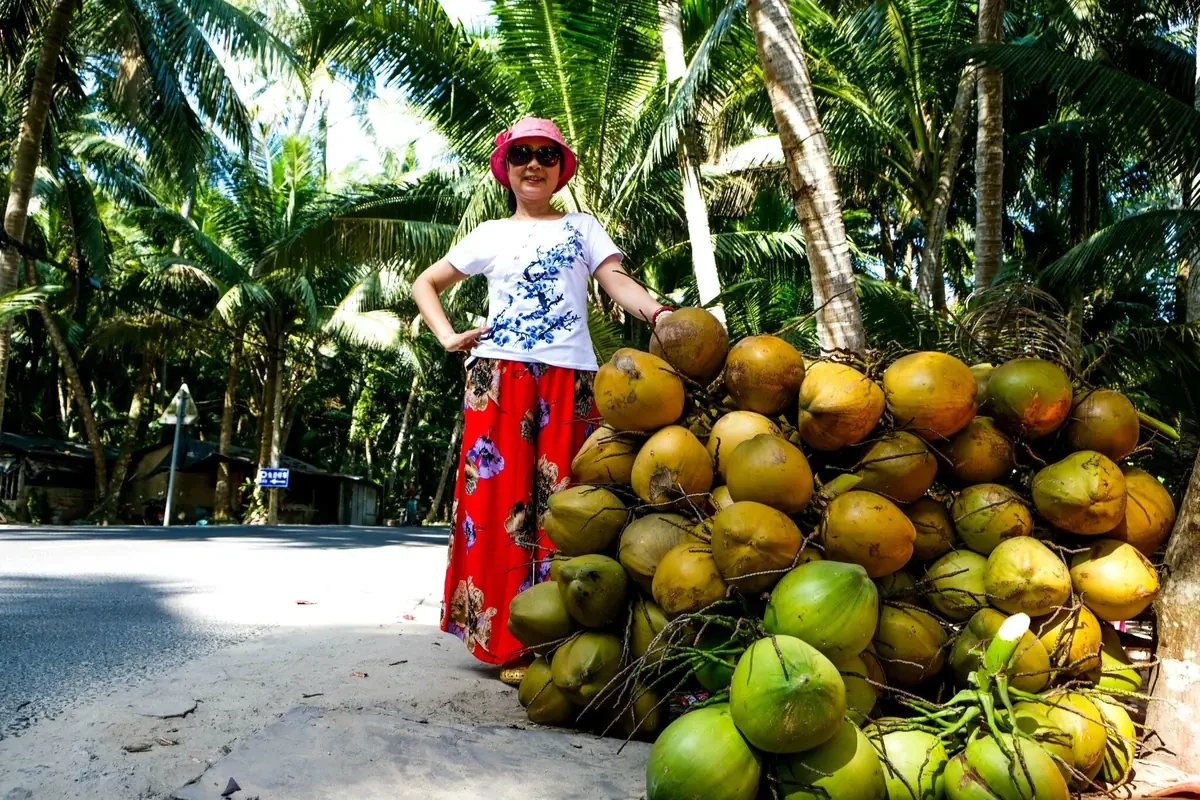
A cheerful moment amid endless coconut palms at Dongjiao Coconut Plantation in Wenchang, Hainan
Your journey begins at Wenchang’s Dongjiao Coconut Plantation, a sprawling coastal forest of over half a million coconut palms. The air here is thick with salt and the sweet, green scent of growing fruit. Narrow sandy paths wind between the trees, and every few hundred metres you pass a small family compound: a cluster of brick houses, a vegetable patch, a few free-range chickens scratching in the shade.
This is where you meet Uncle Chen, a wiry, shirtless farmer in his sixties, his skin baked to the colour of the palm trunks around him. He wears a wide grin that reveals a single silver tooth, and he greets you by cracking open a green coconut with three swift strokes of a machete, then handing it to you with a small bow. The water inside is cool, faintly sweet, and utterly unlike anything from a carton. You drink it standing in the dappled shade, while Uncle Chen tells you about the trees, some planted by his grandfather, some by his father, all known by name and character.
Then comes the moment you came for. Uncle Chen straps a rough safety belt around your waist, just a length of canvas and a rusty clip, and ties it to the trunk of a towering coconut palm. He demonstrates the technique: feet gripping the trunk’s rough ridges, body arched back, a rhythmic push-and-pull that propels you upward like a caterpillar. “Thirty years ago, I could do it in ten seconds,” he says with a wink. You take two minutes, your thighs burning, your hands slipping on the bark, but eventually you reach the canopy and slap the topmost frond in triumph. Uncle Chen applauds from below, then shimmies up in seconds himself to cut down a heavy cluster of green nuts. The descent is harder; your arms shake, but when your feet touch the ground, you feel like you’ve just won a medal.
Climbing done, Uncle Chen leads you down a sandy path to a small, open-sided shed deep in the plantation. Here, the coconut trees give their other gift. A series of bamboo tubes protrude from the trunks, and from each one, a thin stream of milky coconut sap drips into a clay pot. The sap is collected slowly, drop by drop, a process that has been carried out this way for generations. By noon, Uncle Chen’s wife arrives, a quiet, weathered woman in a conical hat, and begins the alchemy. She pours the collected sap into a wide, shallow iron wok set over a wood fire and stirs continuously with a long-handled wooden paddle. For two hours, the sap simmers and thickens, the steam carrying a scent of caramel and tropical flowers. What emerges is palm sugar: dark, smoky, granular, and deeply complex, nothing like the refined white stuff back home. Uncle Chen breaks off a small chunk and offers it to you. It crunches between your teeth, then melts into a warm sweetness that tastes of smoke and sunshine. You buy a small sack to take with you, knowing it will transform anything from a morning coffee to a roasted sweet potato.
Tanmen: The Fishermen’s Port
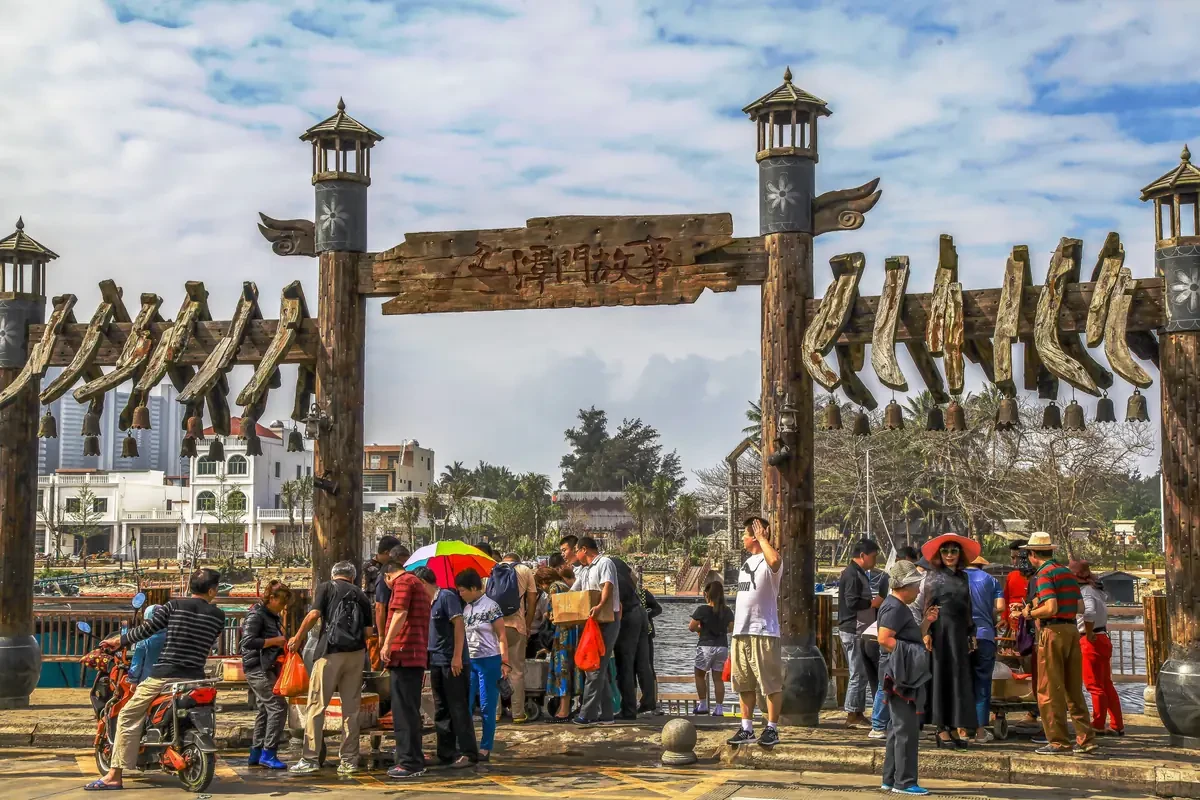
Crowds gather beneath the weathered wooden gate carved with “Tanmen Story” at Tanmen Central Fishing Port in Bo’ao, Qionghai
From Wenchang, a shared minibus rattles south along the coast to Tanmen, a fishing port near Bo’ao that most foreign visitors have never heard of. Here, the harbour is not a marina filled with yachts but a working waterfront where generations of fishermen have built their lives on stilts above the tidal flats. The stilt houses are simple wooden structures on legs of ironwood, connected by narrow plank walkways that creak with every step. At high tide, the water laps just beneath the floorboards; at low tide, the mudflats are exposed, dotted with tiny crabs and probing egrets.
You stay in a stilt house owned by a fisherman named A-Qiang, a bear-like man with hands as rough as sandpaper and a booming laugh that rattles the windows. His home is modest, a clean room with a mosquito net, a shared bathroom, and a small balcony overlooking the sea, but the welcome is five-star. A-Qiang’s wife, a plump woman with a permanent smile, immediately presses a cup of thick Hainanese coffee into your hands, brewed with condensed milk and a pinch of salt, the traditional fishermen’s breakfast fuel.
The 5 a.m. Auction
The next morning, you rise at an hour that feels illegal, the sky still purple with pre-dawn light. A-Qiang is already awake, pulling on his rubber boots by the door. He motions for you to follow. Together, you walk the silent plank roads to the dock, where the overnight fishing fleet is just beginning to return. The harbour erupts into life as the first boats chug in, their hulls heavy with silver. Men shout in Hainanese, a dialect all its own, incomprehensible even to Mandarin speakers. The auction is a theatre of controlled chaos: fish of every shape and colour - red snapper, mackerel, grouper, cuttlefish - are flung onto concrete slabs, weighed in hanging scales, and sold within minutes to a chorus of barking bids. A-Qiang wades into the scrum, inspecting gills and eyes with professional detachment. He buys two gleaming mackerel, slipping the fish into a woven bag with the satisfied air of a man who has just closed a major deal.
Back at the house, his wife grills the mackerel over charcoal on a simple wire grate set up on the balcony. The fish is seasoned with nothing more than sea salt and a squeeze of Hainan wild lime, its skin charred and crisp, its flesh white and steaming. You eat with your fingers, standing up, the morning sun now rising over the South China Sea, turning the water from grey to gold. There is rice, there is pickled radish, and there is a communal silence that speaks of honest hunger and honest food.
Mending Nets and Diving for Urchins
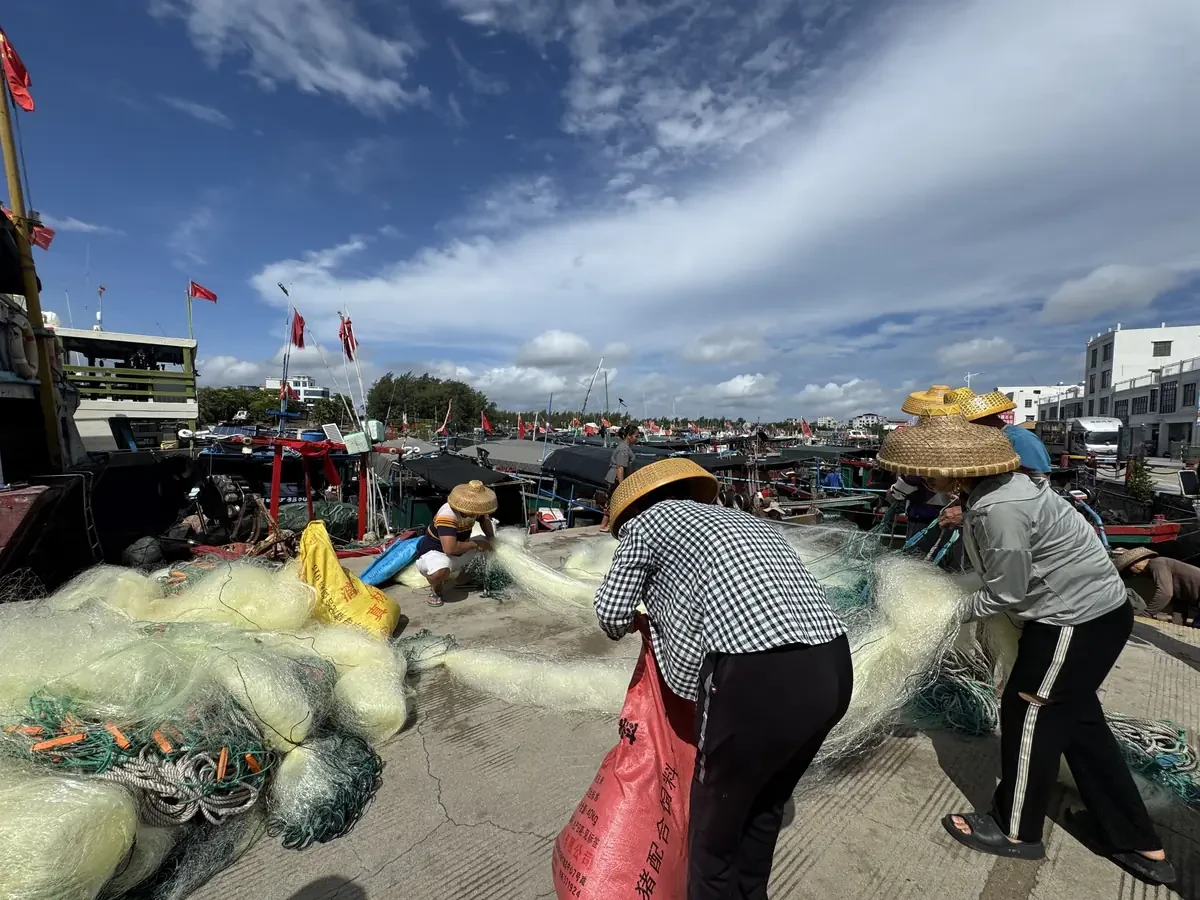
Local fishermen and women carefully untangle and mend their fishing nets, getting fully prepared before their upcoming offshore trips
In the afternoon, you sit on the shaded platform behind the house and help A-Qiang mend his nets. It is slow, painstaking work, threading thick nylon twine through wooden needles, tying knots that must hold against the ocean’s pull, but it is also strangely absorbing. A-Qiang tells you stories as you work: about the typhoon of 2014 that nearly destroyed his house, about the son who studies in Haikou and never wants to fish, about the night he saw a pod of pink dolphins playing in the bow wave of his boat. His Mandarin is heavily accented, but his hands are eloquent, and you understand more than you expect.
Later, A-Qiang takes you out in his small wooden boat, just big enough for two. He navigates by instinct, steering toward a sandbar that emerges from the sea like a mirage at low tide, a sliver of blinding white sand surrounded by shallow, glass-clear water. While you wander the sandbar collecting tiny cowries and spiralled conch shells, A-Qiang dives. He surfaces minutes later, gasping, a mesh bag in one hand filled with spiky black sea urchins. He cracks one open on the gunwale with the back of his knife, scoops out a strip of bright orange roe, and offers it to you. It tastes of the ocean in its purest form, briny, creamy, and slightly sweet. He squeezes a wild lime over another piece, and the acid cuts through the richness like a beam of light. You eat six more, sitting cross-legged on the boat, the only sound the soft lap of waves against the hull.
The Coast Belongs to the Fishermen
That night, back at the stilt house, A-Qiang’s wife cooks the remaining sea urchin into a thick, golden porridge with ginger and spring onion, while A-Qiang pours glasses of a fiery homemade liquor infused with goji berries. You sit on the balcony as the stars come out, undimmed by city lights, reflecting on the still water between the houses. In the distance, a fish eagle cries. The resorts of Yalong Bay feel like another planet. Here, on this quiet wooden platform over the sea, Hainan reveals its truest self, not a manufactured paradise, but a living, breathing coast where the old ways endure and strangers are treated as honoured guests.
Into South China Opens the Door
Hainan’s resorts are nice, but the coast belongs to the fishermen, and they’re happy to share it, if you know how to ask. That’s the role of Into South China. We arrange homestays with families like Uncle Chen’s and A-Qiang’s, who are eager to welcome curious travellers into their daily lives. We provide the transport, the county bus tickets and private transfers, the bilingual guide who can translate Hainanese dialect and local customs, and the personal touches: the safety belt for your coconut climb, the boat for the sandbar, the wild lime for the sea urchin. Our deep roots across Guangdong, Guangxi, Hainan, Hong Kong, and Macau mean we can weave these intimate, unscripted experiences into a larger South China journey, handling every detail so you can simply show up and belong. Contact us to discover the Hainan that lives far beyond the beach resort. The fishermen are waiting.
Client Review
"Hainan exceeded all our tropical paradise expectations! Pristine beaches, world-class resorts, and the unique Li minority culture made this trip unforgettable. Surfing at Riyue Bay, exploring volcanic geoparks, and relaxing in natural hot springs – perfect blend of adventure and relaxation."
Trip Highlights
- ✓
Pristine Beach Experience
Yalong Bay's powder-white sands and crystal-clear waters, Haitang Bay's luxury resorts, Wuzhizhou Island's coral reefs
- ✓
Li & Miao Culture Discovery
Visit ethnic villages, witness traditional textile weaving, learn about betel nut customs and unique minority heritage
- ✓
Tropical Adventure Activities
Surfing at Riyue Bay, diving in Sanya, volcanic geopark exploration, Xinglong botanical garden tours
- ✓
Wellness & Relaxation
Guantang natural hot springs, Nanshan Buddhism Park meditation, fresh tropical fruits and Hainan chicken rice