
Here’s an adventure for travelers who hate airports and love stories, an overland journey that trades departure lounges for railway concourses, security queues for seaside markets, and in-flight meals for oyster omelettes cooked on a cart. It begins in the neon embrace of Hong Kong and ends three days later among the coconut groves of Hainan, with every unhurried kilometre in between filled with characters, flavours, and the kind of serendipity that only ground travel can deliver.
Hong Kong: Cha Chaan Teng and Temple Street
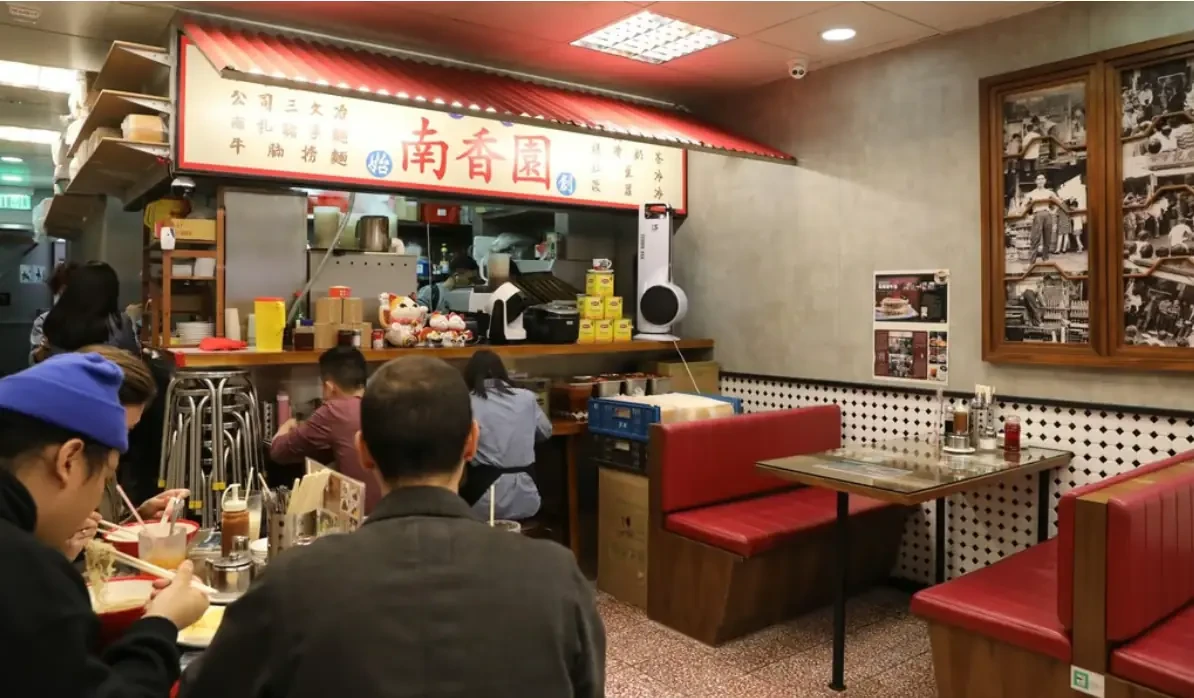
Step inside Sun Hang Yuen, a classic local cha chaan teng hidden in Sham Shui Po, Hong Kong
You start in Hong Kong, not in a glossy Central hotel, but in a walk-up guesthouse in Mong Kok, where the real city hums below your window. Your first morning, you slide onto a vinyl stool at a cha chaan teng, a Hong Kong-style diner, on a side street in Sham Shui Po. The air is thick with the hiss of steam wands and the clatter of ceramic cups. You order a yuan yang (a fortifying mix of coffee and milk tea) and a plate of macaroni soup with ham, a breakfast that makes no sense to a Western palate until you taste it: comforting, salty, entirely Hong Kong. The woman behind the counter, Auntie Fong, has been pouring milk tea through a silk stocking filter for forty years. She doesn’t speak much English, but she gestures toward the framed photo on the wall, a younger version of herself standing next to Chow Yun-fat, and gives you a thumbs-up.
Your days in Hong Kong are a warm-up for the journey ahead. You hunt vinyl records in the labyrinth of Apliu Street Flea Market, ride the Star Ferry at dusk for just a few Hong Kong dollars, and eat clay pot rice at a dai pai dong on Temple Street while a fortune teller in a nearby booth reads palms by candlelight. On your final evening, you join an elderly man practising Tai Chi in Kowloon Walled City Park, his slow movements mirrored in the pond behind him. He doesn’t teach you any forms, but he nods approvingly when you attempt to copy him. Hong Kong has given you a taste of the road’s rhythm, unhurried, curious, open.
The Ferry to Macau and the Walk to Zhuhai
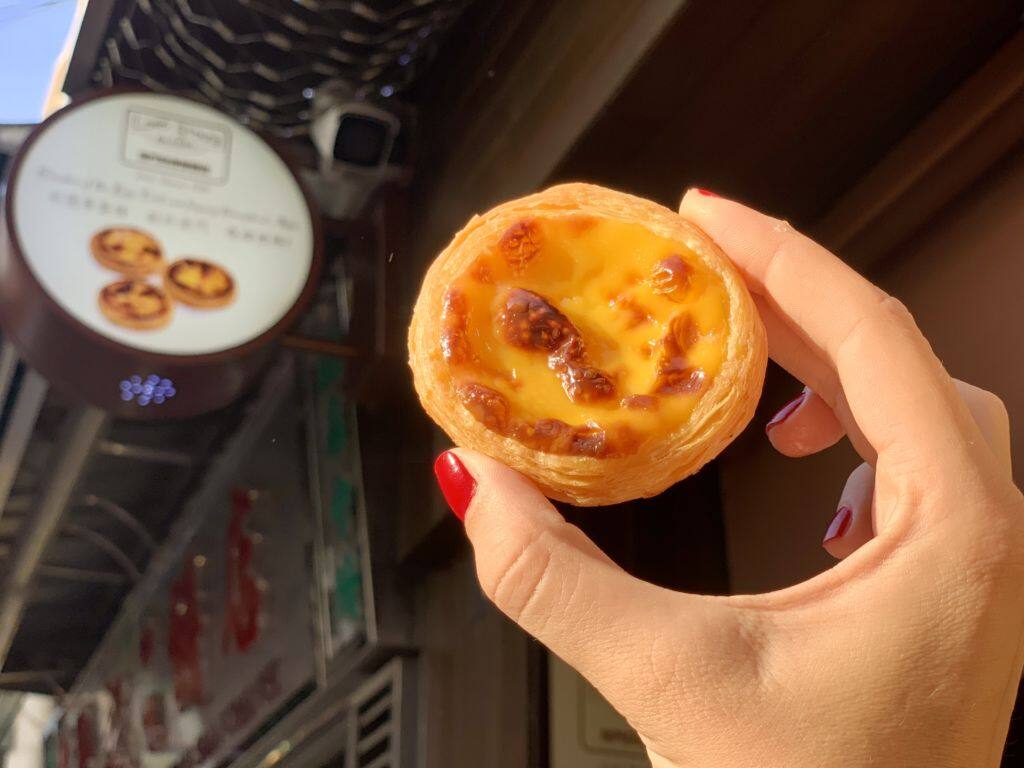
Wandering Macau’s old streets with a classic Portuguese egg tart in hand—pure local flavour
After two nights in the city, you head to the Hong Kong Macau Ferry Terminal in Sheung Wan. The turbojet ferry slices across the Pearl River Delta in an hour, past container ships and fishing junks, the water shifting from muddy brown to a deep marine blue. In Macau, you resist the pull of the Cotai Strip’s casinos. Instead, you make a pilgrimage to a small pastelaria on Rua do Cunha for a still-warm Portuguese egg tart, its custard blistered dark on top, its pastry flaking onto your shirt. Then you walk, not to the taxis, but toward the Gongbei border crossing, where Macau’s Portuguese cobblestones give way to mainland China’s utilitarian concrete.
Crossing the border on foot is an experience in itself. You queue among Zhuhai residents pulling suitcases of Macau-bought milk powder and elderly couples returning from casino day-trips. The immigration officer inspects your passport with practiced efficiency, stamps it, and waves you through. Suddenly, you’re in Zhuhai, a coastal city of wide boulevards and palm trees, its seaside promenade stretching lazily along the South China Sea. You find a comfortable hotel near the railway station, dine on fresh razor clams at a waterfront restaurant, and prepare for the train ride that awaits.
High-Speed South: Zhuhai to Zhanjiang
The next morning, you board a high-speed train at Zhuhai Station, a sleek, white, D-series service that slips out of the Pearl River Delta with the quiet hum of modern engineering. The old green trains that once rattled along this coastal route have mostly vanished from the timetables, replaced by these smooth, punctual services that cover the distance to Zhanjiang in just over three hours. You settle into a comfortable second-class seat by the window, a folding table ready for your cup of tea. The carriage is bright and calm, but it remains a cross-section of southern China in motion: a young woman practises English phrases under her breath, a father builds a Lego dinosaur with his son, and a group of students shares a bag of dried mango, their laughter contained but infectious.
Across the aisle, a man in a polo shirt is carefully cradling a thermal bag on his lap. He introduces himself as Mr. Lin, a seafood trader from Zhanjiang who has been riding this line since its opening. He unzips the bag just enough to reveal a container of live mantis shrimp, their glossy shells clicking faintly against the plastic. “For the restaurant,” he explains with a grin. “Couldn’t take them on the old trains, too bumpy. Now, they arrive calm.” He offers you a tangerine from his pocket and, after you accept, pulls out his phone to show photos of his fishing boat, his grandchildren, and a particularly impressive grouper he landed last spring.
The landscape outside the window transforms in fast-forward: the urban sprawl of the delta dissolves into sugarcane fields, then into the red-earth countryside of western Guangdong. The afternoon light slants through the glass, warming your lap. By the time the train glides into Zhanjiang West Station, you have swapped WeChat contacts with Mr. Lin, carrying a standing invitation to his fishing village. The city’s grip feels far behind you now.
Zhanjiang: The No-Star Guesthouse and the Dawn Market
In Zhanjiang, a gritty port city on the Leizhou Peninsula, you check into a no-star guesthouse near the fishing harbour. The sign is only in Chinese, the lobby smells faintly of dried squid, and the owner, a chain-smoking grandmother in plastic slippers, communicates through gestures and smiles. Your room is basic: a firm bed, a standing fan, a window overlooking the dock, but it’s clean, and the price is less than a coffee in Hong Kong.
You rise before dawn and walk to the seafood market, a vast open-air concrete slab where boats unload directly onto the dockside. The scene is primal and magnificent: trawlers returning from the Gulf of Tonkin, their hulls brimming with silver. Fishermen in rubber boots heave crates of fish, squid, and still-thrashing mantis shrimp onto the wet floor. The air vibrates with the shouts of auctioneers, the slap of fish hitting scales, and the low rumble of ice machines. You watch a woman in a floral headscarf buy a tuna half her size, then strap it to the back of a motorcycle with bungee cords. Nearby, a vendor named Sister Wang runs a breakfast cart, a rickety trolley with a portable gas burner. She pours a ladleful of beaten egg onto a sizzling hotplate, scatters a handful of tiny local oysters, and folds the whole thing into a golden, crispy omelette. You eat it standing in the crowd, the briny sweetness of the oysters cutting through the egg’s richness. It costs eight yuan. It’s unforgettable.
The Train That Sails: Zhanjiang to Haikou
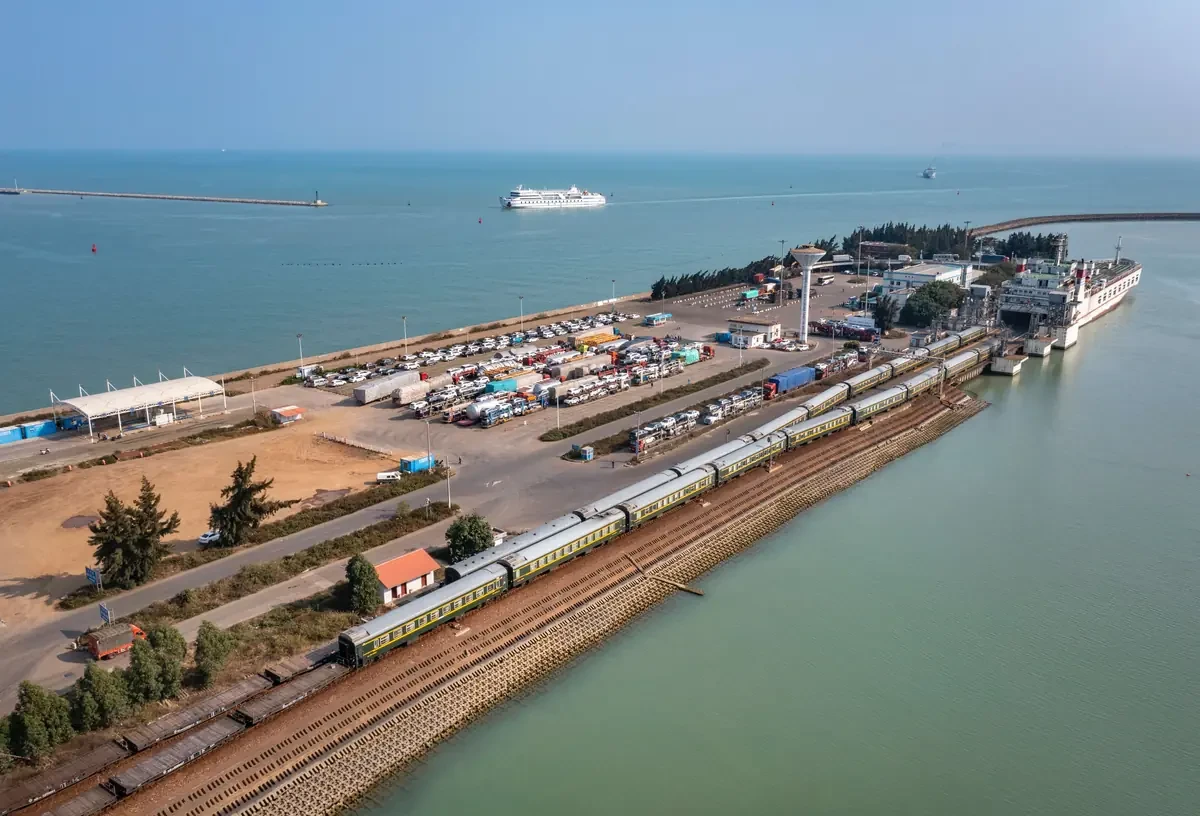
Witness the remarkable rail-ferry connection linking Zhanjiang, Guangdong, to Haikou, Hainan: trains roll straight onto ships to cross the Qiongzhou Strait
That afternoon, you transfer to Zhanjiang’s main station and board the overnight train to Haikou, one of the world’s most unusual rail experiences. This is a conventional sleeper service, the kind that still trundles along the older tracks, and it promises a magic that no high-speed line can replicate. You settle into your hard sleeper berth, a narrow but comfortable bunk with clean sheets, and watch the Leizhou Peninsula fade into darkness. Fellow passengers include a university student returning home, a family with a toddler who waves at you from across the aisle, and an elderly couple who share their homemade zongzi (sticky rice dumplings) wrapped in bamboo leaves.
Around midnight, the train slows to a crawl. A conductor walks through the carriages, announcing something in Mandarin. Outside your window, the usual landscape has vanished, replaced by dark water stretching to the horizon. You’re at the Qiongzhou Strait, the body of water separating mainland China from Hainan Island. And now, the train begins its extraordinary transformation.
With a series of clangs and shudders, the carriages are uncoupled, shunted along a track, and rolled onto the deck of a massive rail ferry. You stay in your bunk the entire time. Looking out the window, you see the train’s reflection in the black water, then the lights of other vessels in the distance, then nothing but an inky sea and a sky salted with stars. The ferry’s engines hum beneath you. It’s surreal, a train car floating across the ocean, its passengers dozing in their bunks, dreaming of coconut palms. The crossing takes about an hour. By the time the train is reassembled on the Hainan side, dawn is breaking, and the island’s tropical silhouette appears on the horizon.
Haikou Sunrise and the Coconut Village
You arrive at Haikou Railway Station just as the sun spills gold over the palm trees. The station is small and a little sleepy, and you find a local bus that rumbles eastward along the coast toward Wenchang. The road passes salt pans glinting in the morning light, and the air grows warmer, thicker, more humid. From Wenchang, you transfer to a minibus, a battered van with lace curtains and a dashboard shrine to the God of Safe Travel, that weaves through narrow lanes lined with coconut groves until it stops at the entrance of a small village.
Here, you find the farmer Uncle Chen (also featured in our Hainan village guide), the same wiry man who has been climbing coconut trees since he was a boy. He straps a canvas safety belt around your waist and teaches you to shimmy up a palm trunk, your feet gripping the bark, your thighs burning. You take two minutes to reach the top; he could have done it in ten seconds in his youth. When you descend, covered in sweat and bark dust, he cracks open a green coconut with three swift strokes of his machete and hands it to you with a small bow. The water is cool, sweet, and utterly unlike anything from a carton. That night, you sleep in a spare room in Uncle Chen’s house, the window open to the sound of rustling palm fronds and the distant murmur of the sea. His wife cooks a whole chicken poached in coconut milk, and you fall asleep with a full stomach and a mind full of the road you’ve just travelled.
The Point of the Journey
Yes, it takes three days to go from Hong Kong to Hainan this way. But in those three days, you’ve met a seafood trader on a high-speed train, a market auntie who cooked you breakfast, a carriage of strangers who shared their dumplings, and a coconut farmer who applauded your tree-climbing efforts. You’ve eaten oyster omelettes on a concrete dock, watched your train sail across the sea, and arrived not at an airport baggage carousel but in a quiet village where the roosters wake you at dawn. The journey is not a hassle to be endured; it’s the entire adventure, and it’s all in South China.
Your Overland Adventure, Seamlessly Crafted
This kind of multi-day, multi-mode journey can feel daunting to piece together alone: the train tickets, the guesthouses, the language gaps, the border crossings. That’s where Into South China steps in. We design overland itineraries for travellers who prefer the road less rushed, handling every logistical thread: the high-speed rail bookings, the Zhanjiang guesthouse, the overnight sleeper and rail-ferry tickets, the coconut village homestay, and private transfers when needed. We provide a bilingual guide (either in person or on standby) who can translate the seafood trader’s stories, decode the train announcements, and ensure that every connection is seamless. Our deep local knowledge across Hong Kong, Guangdong, and Hainan means you can surrender to the journey’s rhythm without worrying about the details. Contact us to begin your own no-flights, no-fears adventure through South China, where the road itself becomes the destination.
Client Review
"Following the colonial history trail along China's coast was fascinating! Hong Kong's Victorian-era architecture, Macau's Portuguese heritage with colorful buildings and amazing Macanese cuisine, then Hainan's tropical beaches for relaxation. A perfect historical and cultural journey."
Trip Highlights
- ✓
Hong Kong Colonial Architecture
Central District's Victorian-era buildings, Former Legislative Council, Stanley Market, Repulse Bay's colonial charm
- ✓
Macau UNESCO Heritage Walk
Ruins of St. Paul's, Macau Museum, Taipa Village's colorful Portuguese houses, historic center exploration
- ✓
Portuguese-Macanese Cuisine
Authentic Macanese restaurants serving unique fusion dishes, egg tarts, African chicken, pork buns in old alleyways
- ✓
Hainan Tropical Paradise
Haikou's French quarter, Sanya's pristine beaches, Nanshan Temple, duty-free shopping, farewell seafood banquet


