
It starts in Guangzhou, but not the shiny Zhujiang New Town of glass towers and designer boutiques. Instead, you slip into the quieter lanes of Liwan, the historic heart of old Canton, where the buildings still wear their weathered lime-wash facades, and the air carries the scent of simmering herbal tea from shops that have stood for a century. Here, you check into a homestay in a narrow qilou arcade building. Your host is a retired dim sum chef named Auntie Lam, who has lived in this neighbourhood since she was a girl. Her home is modest, with polished concrete floors, wooden furniture darkened with age, and a small altar to the kitchen god near the stove, but the welcome is immediate and warm. She hands you a pair of cloth slippers and a cup of aged pu'er tea before you've even set down your bag.
Morning Lessons in a Liwan Kitchen
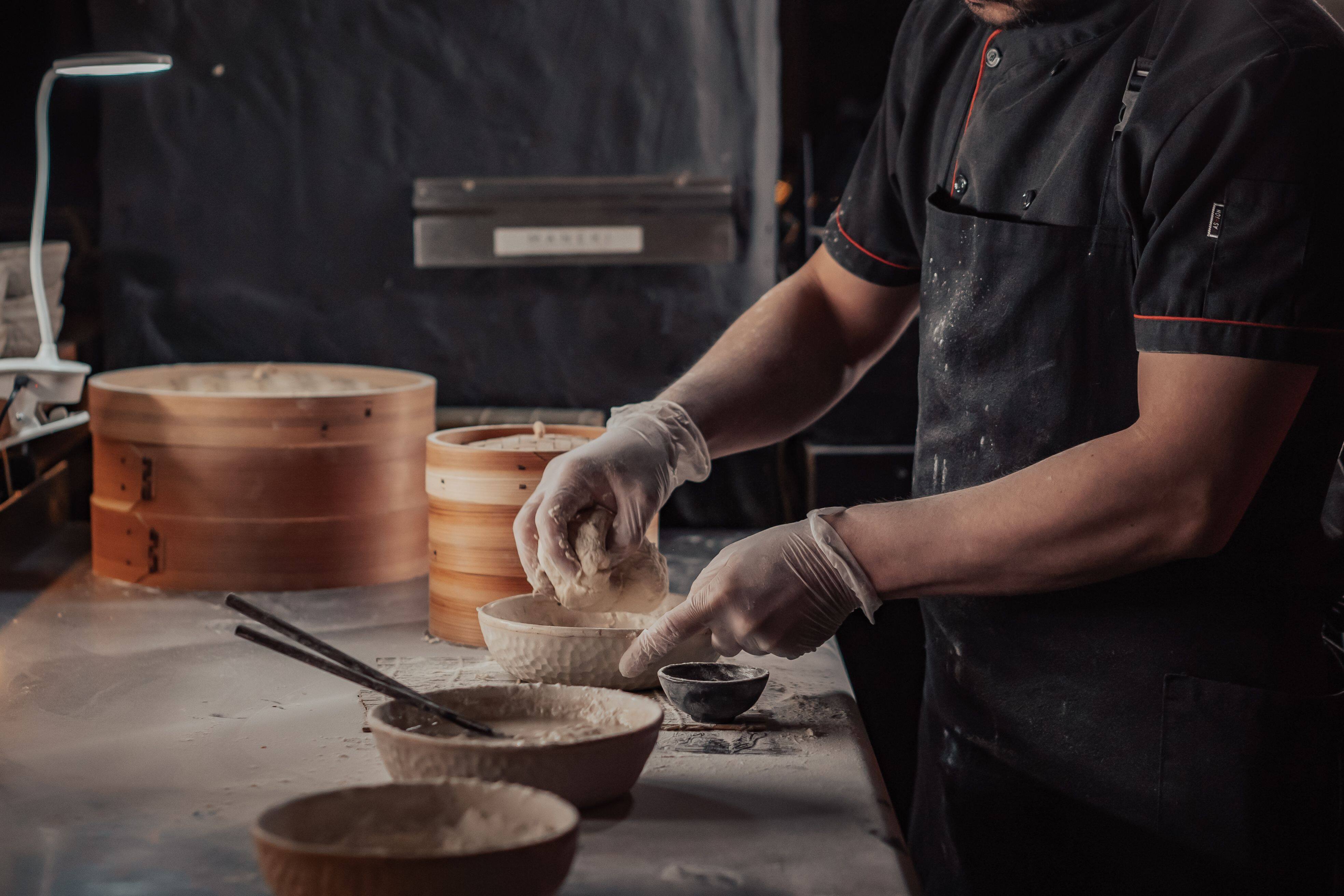
A chef wearing gloves prepares dough with ingredients in a dimly lit kitchen
At seven the next morning, Auntie Lam ties an apron around your waist and stands you before her well-worn wooden worktable, its surface smooth from decades of kneading. Today, you learn to wrap siu mai. She shows you the dough first, a simple mixture of wheat starch and boiling water, worked quickly while still steaming hot. Then the filling: minced pork, whole shrimp, shiitake mushrooms, and a whisper of sesame oil. She demonstrates the technique: a circular wrapper held in the left hand, a spoonful of filling pressed into the centre, then a gentle gathering motion with thumb and forefinger to pleat the edges upward, leaving the top exposed like the petals of a flower. Your first attempts are lumpy, misshapen things that Auntie Lam politely calls "creative." By the tenth, something clicks. When the bamboo steamers are lifted from the wok twenty minutes later, the siu mai inside are yours, plump, glistening, and deeply satisfying. You eat them at her small kitchen table, dipping each one into a dish of red vinegar and chilli oil, while Auntie Lam tells stories of the old Guangzhou: the night markets that once filled the streets outside her door, the opera singers who rehearsed in the temple courtyard, the time she made a thousand har gow for a wedding banquet.
High-Speed Journey: Guangzhou to Nanning
That afternoon, you leave Auntie Lam’s kitchen and take the metro to Guangzhou South Railway Station, a soaring cathedral of glass and steel where departure boards flicker through Mandarin and English. The old green trains have mostly faded from the schedules, their hard seats and twelve-hour trundles replaced by sleek high-speed services that swallow the distance to Nanning in a little over three hours. You settle into a comfortable seat beside a window that frames the world like a widescreen film. The carriage is calm, almost library-quiet, but it’s still a cross-section of southern China in motion: a university student taps through a mobile game, a young couple shares a bag of dried mango, and a father in a polo shirt is coaxing his toddler to say “grandma” into a phone.
The woman across the aisle is Mrs. Huang, travelling to Nanning to visit her daughter. She pulls a foil packet of boiled peanuts from her handbag, still warm from her own kitchen, and insists you take a handful. The shells are soft from the boil, the peanuts salty and tender. She tells you about her daughter, a university lecturer, and asks about your journey with genuine curiosity. Beside her, a man in a light jacket cradles a cardboard box stamped with the name of a Yulin pomelo farm. He flips open the lid just enough to reveal the pale green fruit inside, releasing a faint citrus scent into the recycled cabin air. “For my nephew,” he explains. “His first job.”
The train slides out of the Pearl River Delta with an effortless smoothness (see our high-speed rail guide), the urban sprawl thinning into sugarcane fields and distant blue mountains. The late-afternoon light slants through the glass, warming your lap. You watch the delta dissolve, the karst peaks of Guangxi shouldering their way onto the horizon. Their silhouettes grow sharper as the sun sinks, and you feel the city’s grip loosening from your shoulders with every passing kilometre. When the train glides into Nanning Station a little after dusk, you’re rested, alert, and already half-rooted in the rhythm of the road.
Nanning's Hidden Corners
You arrive in Nanning, the capital of Guangxi, a city often dismissed as a transit hub. But you know better. Instead of the zoo or the gleaming shopping malls, you head to the Tangshan Road Antique Market on a Sunday morning. This is not a tourist attraction; there are no English signs, no guided tours. It's a dusty, sprawling bazaar where locals come to hunt for treasures both real and imagined. Stalls spill onto the pavement, their goods laid out on tarpaulins or balanced on rickety tables: Cultural Revolution-era Mao badges with faded enamel, old vinyl records by Cantopop stars long forgotten, tarnished silver hairpins, calligraphy scrolls with cracked silk mounts, and jade bangles of every shade of green. A vendor, an old man with a magnifying loupe screwed into one eye, holds a piece of pale celadon jade to the light and debates its authenticity with a customer for twenty minutes. The argument is theatrical, almost operatic, and ends with both men laughing, and the jade sold for a price neither will reveal. You pick up a small copper teapot, its handle shaped like a dragon, and the vendor tells you it belonged to a tea merchant in Liuzhou seventy years ago. Whether that's true is beside the point.
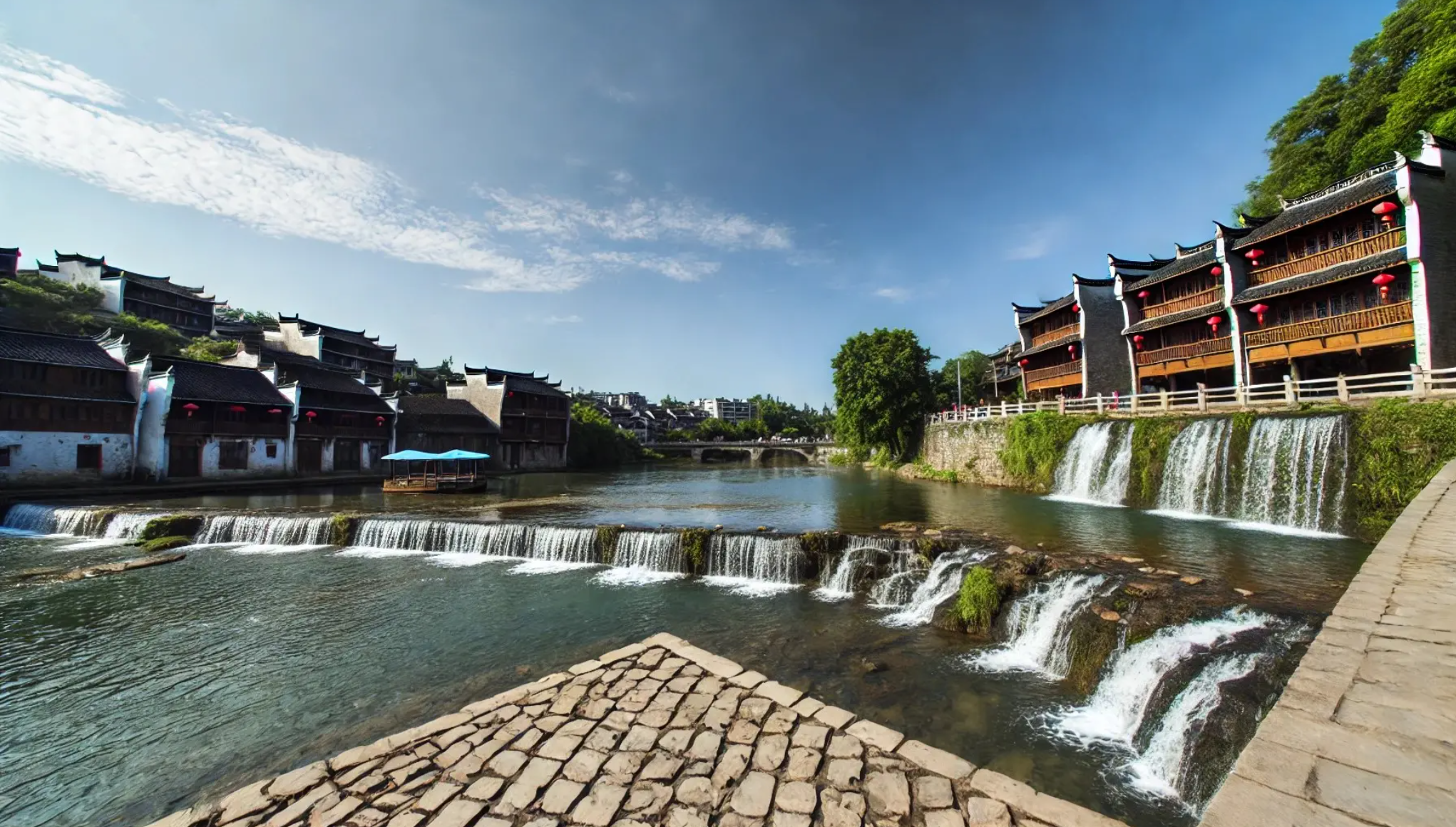
Serene cascading waterfalls frame traditional wooden stilt houses at Yangmei Ancient Town, making it a unique spot for relaxation
From the market, you take a rural bus, the kind with lace curtains on the windows and a driver who honks at every passing scooter, to Yangmei Ancient Town, an hour outside the city. This is not a ticketed heritage site with souvenir shops and audio guides. It's a living village, its stone lanes worn smooth by centuries of footsteps, its Ming and Qing dynasty courtyard houses still inhabited by the descendants of the families who built them. There is no ticket booth. There are no souvenir shops. Instead, a woman is sitting on her doorstep weaving straw sandals, her fingers moving with a rhythm that speaks of a lifetime's practice. A village doctor is grinding dried herbs with a stone mortar and pestle in a dark, fragrant shop, his prescriptions still written with a calligraphy brush. There is a tiny temple dedicated to the God of Literature, its incense coils hanging from the ceiling like beehives, their smoke curling lazily in the afternoon heat. You wander for hours, and no one asks you for money. They simply nod, smile, and continue their day.
Beihai: The Fishing Port at Dawn
From Nanning, another high-speed train carries you south to Beihai, a coastal city on the Gulf of Tonkin. The journey takes barely an hour and a half, but the landscape changes completely, karst peaks flatten into coastal plains, and the air grows saltier with every passing minute. You're not here for Silver Beach, the crowded stretch of sand lined with high-rise hotels. Instead, you head to Qiaogang, a fishing port settled decades ago by ethnic Chinese returning from Vietnam, and the neighbourhood still hums with that unique cultural blend. You stay in a small guesthouse run by a family whose grandmother crossed the border in 1979 with nothing but a wok and a bag of rice seeds. The walls are decorated with faded photographs of fishing boats and family ancestors.
At 5 a.m., you're not in bed. You're standing at the Qiaogang Fish Auction, a cavernous concrete hall by the harbour where the overnight fleet unloads its catch. The scene is raw, loud, and magnificent. Tuna and grouper as long as your arm are slapped onto metal tables still dripping with seawater. Buyers, mostly restaurant owners and market vendors, circle the tables with a predator's focus, shouting bids in a mix of Cantonese and Vietnamese. The auctioneer chants in a rapid, incomprehensible rhythm, a song of commerce that rises and falls. A stall owner, a woman in rubber boots named Sister Mei, spots you watching and grins. Before you can protest, she's grilling an oyster omelette on a portable gas burner set up on a crate. The oysters are tiny, sweet, and still dripping brine; the egg is beaten with fish sauce and a handful of bean sprouts, then poured over the sizzling seafood. She hands you the finished omelette on a paper plate with a plastic fork. You eat it standing amid the chaos, and it's one of the best breakfasts of your life. Before you leave, Sister Mei points you toward the edge of the harbour, where the local fishermen's association runs a small museum dedicated to the Vietnamese-Chinese community. It's little more than a single room filled with black-and-white photos and handwritten letters, but it tells a story of displacement, resilience, and fish sauce, a condiment that connects this town to its past.
Weizhou Island: The Volcanic Edge
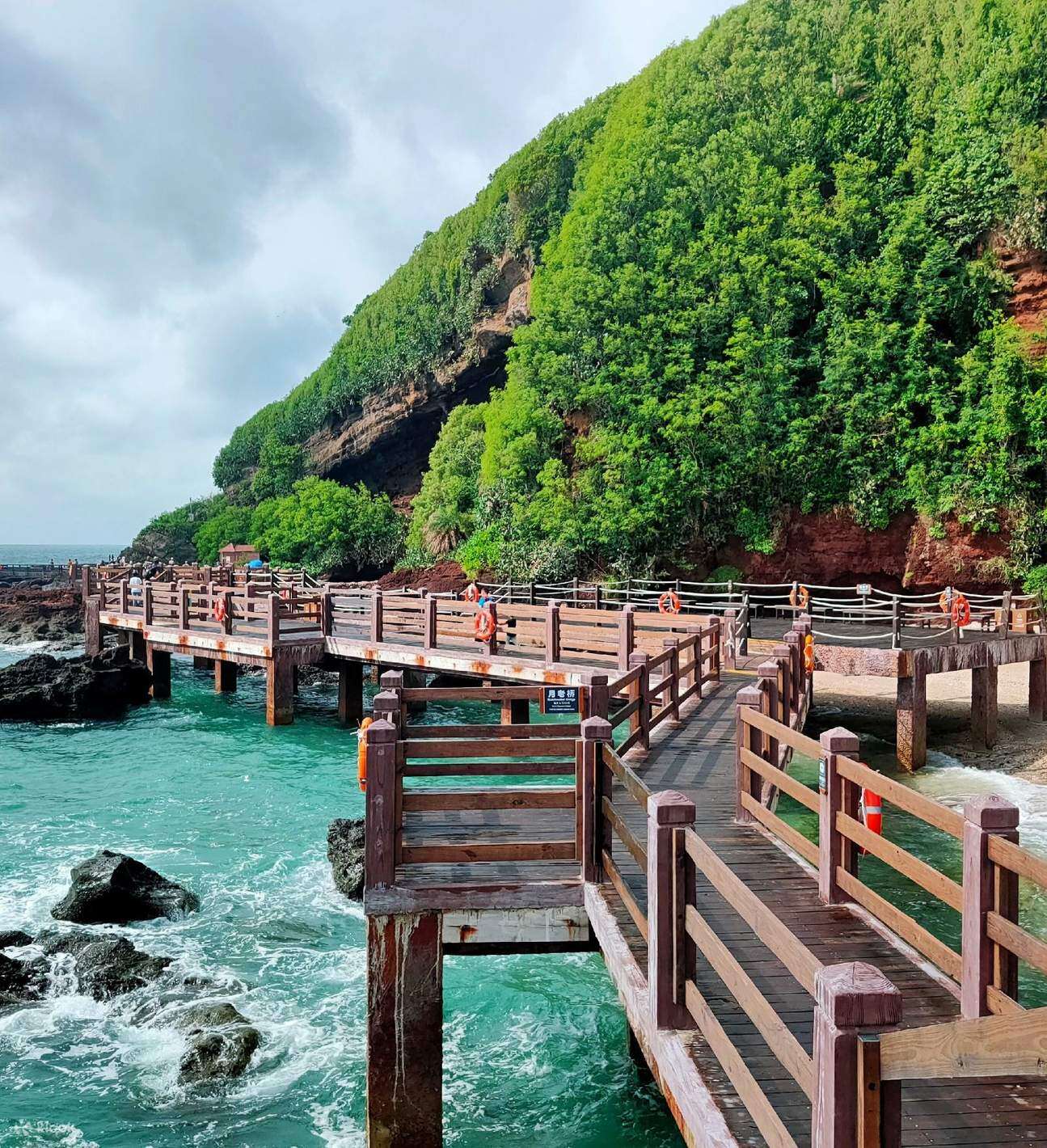
Wander the seaside wooden walkway of Weizhou Island, surrounded by lush green volcanic rock cliffs and crashing clear blue waves
Finally, you take the local ferry from Beihai to Weizhou Island, China's largest volcanic island, formed by ancient eruptions that left behind black basalt cliffs and fertile red soil. Most day-trippers cluster around the few developed beach coves near the pier. But you rent an e-bike, its basket already holding a hand-drawn map from your guesthouse owner, and ride to the island's far side, where the roads turn to gravel and then to sand.
Here, a small community of fishermen lives in stilt houses perched above the rocky shore, their wooden legs reinforced with coral stones. Squid and fish hang from bamboo racks to dry in the sun, their translucent bodies glowing amber. A fisherman named Lao Wei, his face as weathered as the basalt cliffs, waves you over. He's pulling in a net from the shallows, a slow, rhythmic labour that requires leaning back with your whole body. He hands you a section of the net without ceremony. You pull. The net is heavy, and the coarse rope burns your palms, but you pull until three small silver fish flip onto the sand, a modest catch, but yours. Lao Wei grins, his teeth stained from betel nut, and gathers driftwood for a fire. Within minutes, the fish are gutted and grilled on a simple wire grate, seasoned with nothing but seawater spray and smoke. You eat them with your fingers, the flesh flaking from the bone, and watch the sun sink into the Gulf of Tonkin, painting the basalt cliffs in shades of rust and gold. The island's only sounds are the crackle of the fire, the hiss of small waves, and Lao Wei humming a Vietnamese fishing song his grandfather taught him.
On your last morning, you rise early and ride the e-bike to the island's Catholic church, a weathered Gothic structure built by French missionaries in the 1850s, incongruous and beautiful among the banana trees. A small congregation of islanders is gathering for mass, their Hainanese-accented hymns drifting through the coral stone walls. You sit in a back pew, listening, and feel impossibly far from the Guangzhou skyscrapers where this journey began.
Into South China Crafts Your Slow Journey
This is not a luxury escape. It's a slow, beautiful journey through South China's layered landscapes, and it requires someone who can translate not just the language, but the unspoken codes of the road. Into South China designs these unhurried itineraries for travellers who want more than checklists. We arrange your Liwan homestay with a host like Auntie Lam, book your high-speed rail tickets and comfortable seats, and provide a bilingual guide who can explain the history behind a Mao badge or the proper way to haggle for jade. We know which Qiaogang guesthouse has the best harbour views, which Weizhou e-bike rental shop has the most reliable batteries, and which fisherman is willing to let a stranger pull his net. Our roots across Guangdong, Guangxi, Hainan, Hong Kong, and Macau mean we can weave this slow journey into a larger South China adventure, handling every logistical thread. Contact us to begin your own slow road, from a Liwan kitchen at dawn to a volcanic island at sunset, with a thousand small, human moments in between.
Client Review
"This was the real South China experience we craved! Living with a Liwan homestay family who taught us to wrap siu mai, riding a green K-train with locals sharing boiled peanuts, haggling at Nanning's Tangshan Road Antique Market, watching the 5am fish auction in Beihai's Qiaogang fishing town, and pulling nets at sunset on Weizhou Island. No tourist traps, just authentic daily life."
Trip Highlights
- ✓
Liwan Homestay Experience
Live with a local family in Guangzhou's old Liwan district, learn to wrap siu mai (pork dumplings) from your host, experience authentic Cantonese morning routines
- ✓
Green K-Train Adventure
Twelve-hour hard seat journey to Nanning with window open, share boiled peanuts with fellow passengers, meet locals transporting live chickens to market
- ✓
Nanning Local Markets
Tangshan Road Antique Market haggling for Mao badges and vinyl records, Yangmei Ancient Town stone lanes with elderly women weaving straw sandals
- ✓
Beihai Fishing Town Life
5am fish auction at Qiaogang Vietnamese-Chinese fishing town, fresh oyster omelette grilled on the spot, local ferry to Weizhou Island
- ✓
Weizhou Island Fisherman Experience
Rent e-bike to explore stilt houses, help fishermen pull nets at sunset, grill freshly caught fish over driftwood on the beach


