Stand at the base of DJI's Sky City in Shenzhen's Nanshan district, and the building does exactly what great architecture should: it makes you feel something. Two asymmetrical towers, connected by suspended sky bridges, float above the ground like a drone hovering in mid-air. The glass catches the subtropical light differently at every hour. It is easy to photograph and easy to admire. But the building is not the story. The story is a series of decisions, most of them invisible, that explain why this structure stands in Shenzhen rather than Hong Kong, Silicon Valley, or anywhere else.
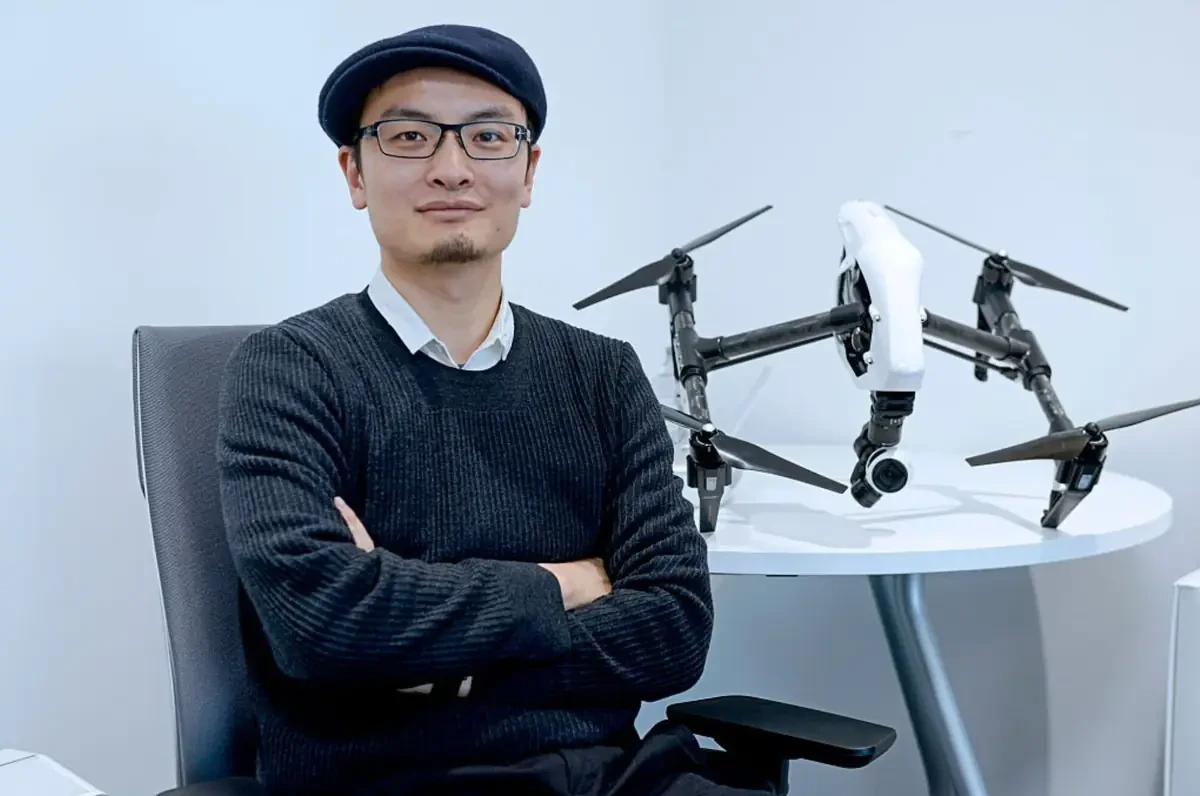
Frank Wang, founder of DJI
When Frank Wang, DJI's founder, was a graduate student at Hong Kong University of Science and Technology in the early 2000s, he faced a choice that would define the company. His research on drone flight controllers was promising, and he had supportive professors who believed in the technology. Hong Kong had capital, international connections, and a legal system familiar to global investors. Beijing had policy access. Shanghai had a sophisticated consumer market. Wang chose none of them. He chose to set up DJI in a Shenzhen apartment, a decision that looked counterintuitive to many at the time but now reads as inevitable.
The logic was simple and profoundly local. Drones are not software products that can be built entirely on laptops. They are physical objects with motors, gyroscopes, propellers, and battery systems that must be sourced, tested, redesigned, and tested again. Shenzhen, by the mid-2000s, had already developed something no other Chinese city could match: a supply chain so dense and responsive that an engineer could modify a design in the morning, walk to a component stall in Huaqiangbei by lunchtime, and hold a revised prototype by evening. Wang understood that proximity to this ecosystem was worth more than any tax break or government incentive. The decision was not about where to locate a company. It was about where to locate a learning process.
Today, when visitors tour DJI's exhibition hall and then pilot a drone in the indoor flight zone, they encounter the polished result of those early choices. But the deeper lesson is not about drones. It is about the architecture of innovation itself. DJI succeeded not because it had a brilliant founder alone, though it did, but because it embedded itself inside a city that collapses the distance between idea and object. If you want to understand why DJI holds over seventy percent of the global consumer drone market, the answer is not in the building. It is in the thirty-minute drive between Sky City and the supply lanes of Huaqiangbei that still feed it.
Huaqiangbei and the iPhone That Traveled Alone
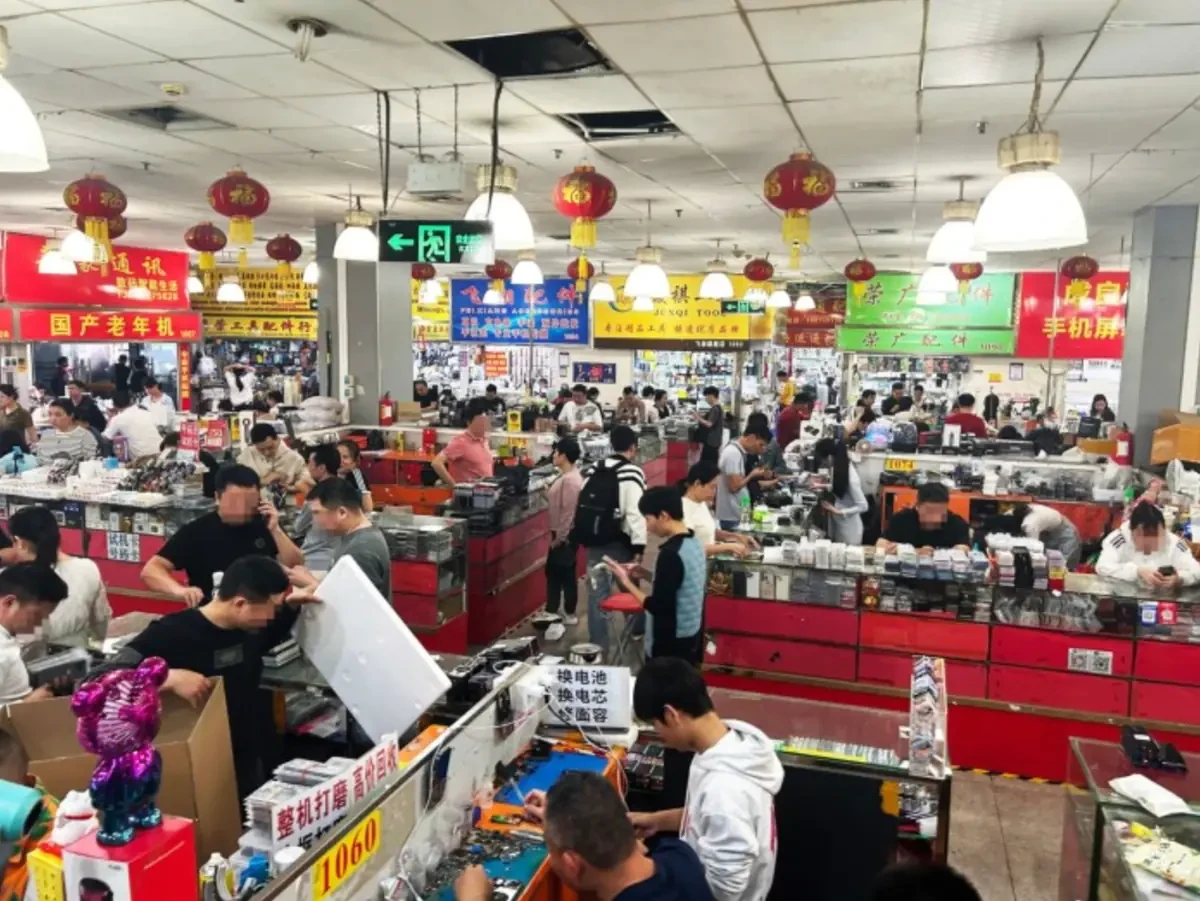
Dense rows of retail stalls specialize in mobile phone repair, spare parts, and consumer electronics inside Huaqiangbei Electronics Market (Source: iphoneislam)
There is a recurring story on TikTok and YouTube that foreign viewers find either fascinating or unsettling. A tourist visits a European capital, perhaps Barcelona or Rome, and has their iPhone stolen from a café table. Days later, using Find My iPhone, they watch their device's location update on a map. It passes through several countries, then arrives at a single point in southern China. The pin drops on Huaqiangbei.
The story is usually told as a cautionary tale about theft, which it is. But it also contains a quieter truth about Huaqiangbei's role in the global technology ecosystem. That stolen iPhone does not end up in Shenzhen because the city is full of criminals. It ends up there because Huaqiangbei is the only place on earth with the concentrated expertise to disassemble, refurbish, test, and resell every component inside it. The screen goes to one vendor. The camera module goes to another. The logic board is tested by a technician who has handled ten thousand identical boards and can diagnose a fault by the way a specific chip heats up under a thermal camera. No other city processes hardware at this scale or with this speed. The market is not just a place to buy things. It is a recycling centre for global electronics, a laboratory for reverse engineering, and an informal training ground for thousands of technicians who learn by taking things apart and putting them back together.
This is the version of Huaqiangbei that most tourists never see. They walk through the consumer-facing floors, past stalls selling phone cases and LED strip lights, and miss the fact that the real intelligence of the market is layered underneath. The component traders, the PCB prototyping services, the small-batch assembly workshops: these are the nodes of a knowledge network that no university could replicate. When a foreign maker arrives in Shenzhen hoping to prototype a new wearable device, they are not just buying parts. They are plugging into a distributed brain that has already solved a thousand problems similar to theirs.
The Chaoshan Network and the Sociology of Trust
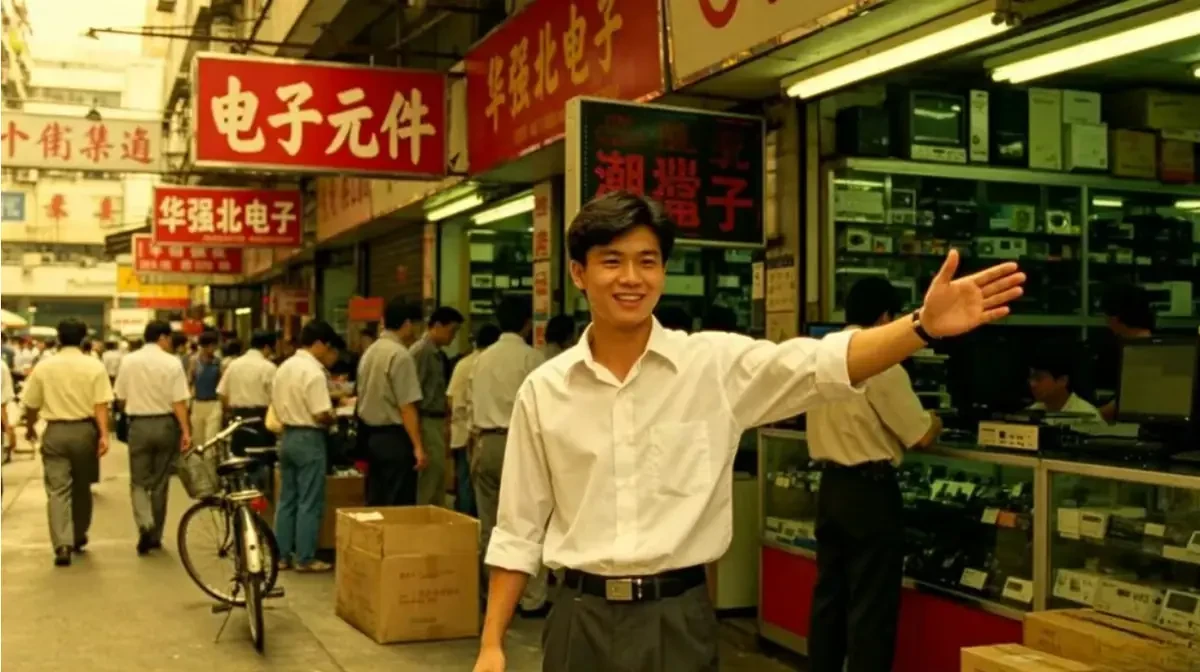
Back to the 1980s Huaqiangbei, Shenzhen, a young Chaoshan pioneer welcoming the world to his electronics stall
One of the less visible but essential layers of Huaqiangbei is the dominance of traders from the Chaoshan region of eastern Guangdong. Chaozhou and Shantou, collectively known as Chaoshan, have produced a diaspora of merchants who have controlled trade routes across Southeast Asia for centuries. Their business culture is built on tight kinship networks, verbal agreements, and a reputation-based system of credit that operates largely outside formal legal contracts. In Huaqiangbei, this culture is the invisible lubricant of the supply chain. A Chaoshan component dealer might extend credit to a buyer she has never met, based on a phone call from a cousin who vouches for him. A factory owner in Dongguan might accept a rush order from a startup founder who shares the same dialect, even if the payment terms are not yet settled.
This trust infrastructure is difficult for outsiders to perceive, but it is one of the reasons Shenzhen's hardware ecosystem moves at such extraordinary speed. Formal contracts and legal due diligence take time. In Chaoshan business culture, a handshake over a cup of gongfu tea can initiate a production run within hours. The system has its risks; disputes do occur, but the social cost of breaking trust within the community is so high that the default behaviour is reliability. For foreign entrepreneurs who arrive in Shenzhen without these social connections, the experience can feel opaque. They struggle to understand why a vendor offers a discount to one buyer but not another, or why a particular factory owner seems willing to take a risk on an unproven design. The answer often lies in relationships that were built years before the foreign visitor ever arrived. Understanding this network, and learning to navigate it with cultural fluency, is what separates a successful hardware launch from a frustrating one.
The TikTok Phone and the Myth of Total Knowledge
In late 2023, a wave of short videos spread across TikTok showing young content creators attempting something audacious: walking into Huaqiangbei with empty hands and the declared goal of assembling a fully functional smartphone from scratch, using only parts purchased from market stalls. Most of these videos were staged or heavily edited, and none of the creators actually produced a working device that could rival a commercial iPhone. But the fantasy resonated because it pointed to a half-truth. You cannot literally build an iPhone from scratch in Huaqiangbei. But you can get closer than anywhere else on the planet.
The market contains motherboards, screens, batteries, cameras, housings, and every other component needed to assemble a functional phone. What it lacks is the proprietary firmware and operating system integration that Apple and Samsung control at the software level. The TikTok creators who failed to build their dream phones were not failing because of a lack of parts. They were failing because Shenzhen's hardware culture, despite its extraordinary density of knowledge, cannot fully replicate the closed, proprietary integration that the world's most profitable tech companies guard as their competitive moat. That limitation is itself an important lesson. Hardware is astonishingly open and accessible in Shenzhen. Software, intellectual property, and brand trust remain the domains where global tech giants still hold the advantage. The companies that succeed in Shenzhen, DJI among them, understood this from the start. They leveraged the city's hardware openness while building their own proprietary software stacks and brand identities.
The Spirit That Holds It Together
What connects these stories - DJI's dorm-room beginnings, Huaqiangbei's second-hand iPhone economy, the Chaoshan trust networks, the TikTok phone experiment - is a shared spirit of trial-and-error that Shenzhen does not merely tolerate but actively encourages. Failure here is not a mark of shame. It is an expected part of the process, a cost of learning that is built into the city's rhythm. A small shop counter in Huaqiangbei that sells phone accessories today might have been selling DVD players five years ago, and might pivot to selling smart home sensors next year. The vendor does not see this as instability. She sees it as an adaptation.
This culture is what Into South China aims to reveal through our tech experiences. We do not simply escort visitors through DJI's exhibition hall or point them toward the busiest stalls in Huaqiangbei. We tell the stories that make sense of what they are seeing. We explain why Frank Wang chose Shenzhen over Hong Kong, and how that single decision shaped the trajectory of an entire industry. We show visitors the Chaoshan tea shops tucked behind the electronics counters, where relationships are maintained, and deals are made. We discuss why that stolen iPhone ended up here, and what that reveals about the city's unique position in the global technology ecosystem. We connect the visible landmarks to the invisible social patterns that produced them.
We believe this is the kind of travel that matters. Not passive sightseeing, but active understanding. Not just seeing what Shenzhen has built, but learning how it was built, and why it could not have been built anywhere else. If that perspective interests you, we would be honoured to share it with you. But even if you never take a tour with us, we hope you now see Shenzhen a little more clearly. The skyline is beautiful. The stories behind it are better.