
Start in Guilin, but don't take the cruise. The Li River will still be there tomorrow, its postcard-perfect karst peaks reflected in the emerald water. For now, walk instead to the city's long-distance bus station, buy a ticket from a window where the clerk speaks no English but smiles warmly at your pronunciation of "Longsheng," and board a battered coach heading north. The bus climbs out of the karst landscape and into the mountains, the road narrowing to a single lane that curls around the contours of the peaks. After three hours, you switch to a shared minivan, the kind with lace doilies on the seats and a small shrine to the God of Safe Travel glued to the dashboard, and wind higher still, past villages of wooden stilt houses and terraced slopes that hint at what's to come.
You arrive at Ping'an Village, a settlement of the Zhuang ethnic minority perched on the edge of the famous Longji (Dragon's Backbone) Rice Terraces. Here, you will stay not in a hotel, but in a family's wooden home. The house is built entirely without nails, its dark timber beams joined by intricate mortise-and-tenon joints, and it smells gloriously of smoked pork and woodfire. Strips of pork belly hang above the cooking hearth, curing slowly in the rising smoke, their edges blackened and glistening with fat. Your host, a Zhuang woman named Mei, welcomes you with a cup of hot mountain tea and a smile that crinkles the corners of her eyes. She wears her dark hair in a coil at the nape of her neck, secured with an old silver pin, and her hands are rough from a lifetime of working the terraces.
Dawn on the Dragon's Backbone
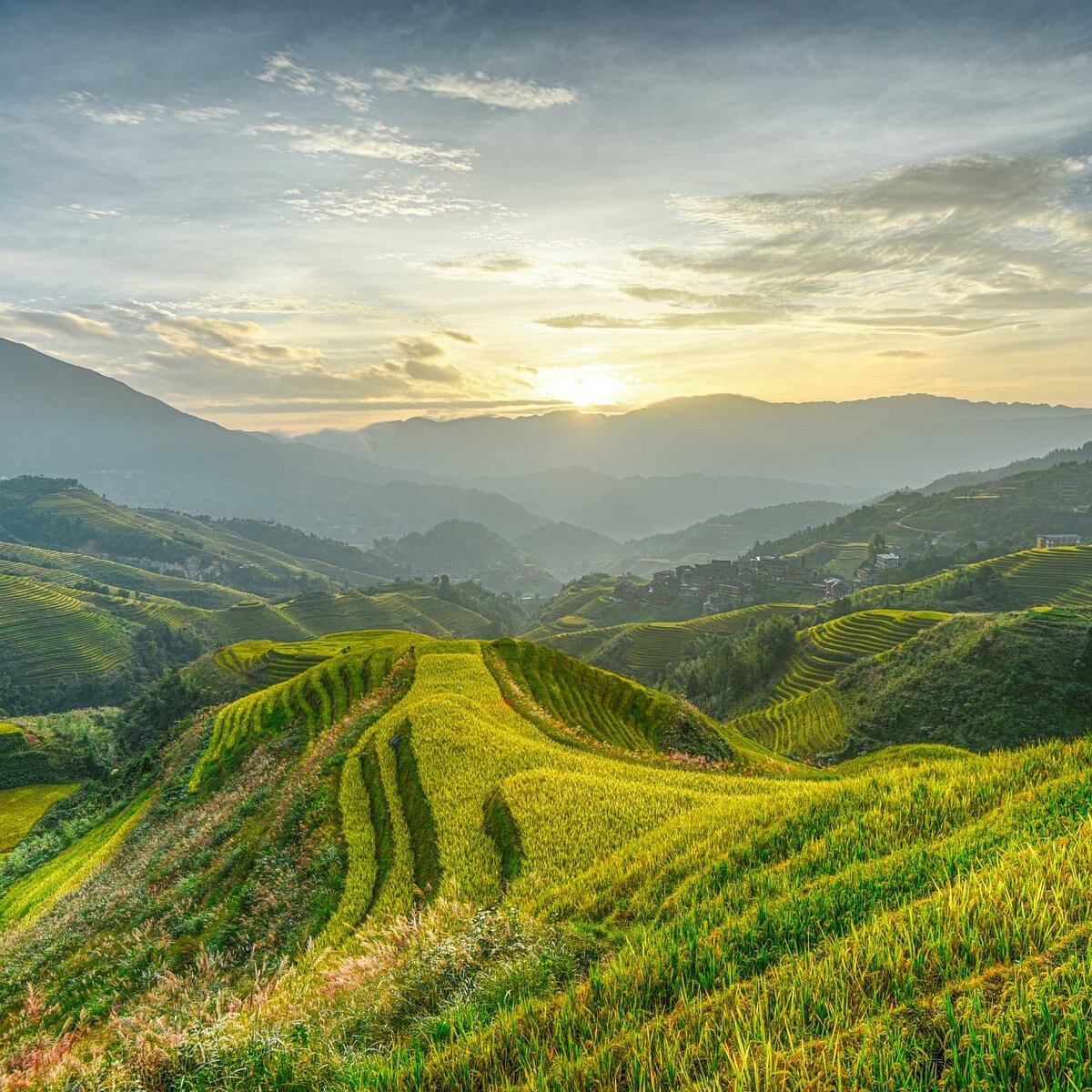
Golden sunrise spills over the layered waves of Longji Dragon’s Backbone Rice Terraces
At 5:30 the next morning, Mei gently knocks on your door. The sky outside is still a deep indigo, the stars just beginning to fade. You pull on your boots and follow her up a narrow dirt path that snakes between the flooded paddies. There is no cable car, no viewing platform, no queue of selfie sticks, just the two of you, the chirp of waking insects, and the sound of water trickling through bamboo irrigation channels. The path is steep and uneven, slick with dew, and Mei walks it with the ease of a woman who has climbed this route every morning since she was a girl. She points out things you would never notice: a wild ginger plant growing beside the trail, the nest of a red-whiskered bulbul in a tea bush, the way the morning mist clings differently to the highest terraces, promising a clear day.
When you reach the summit, the sun breaks over the peaks, and the terraces below you ignite. There are hundreds of them, maybe thousands, a vast staircase of water and young rice shoots, each level catching a different shade of gold, green, and silver. The reflection of the sky shimmers in the flooded paddies, broken only by the slow, deliberate movement of a farmer checking his seedlings. Mei stands beside you, silent, her face bathed in the new light. After a long moment, she says quietly, "My great-grandfather built these terraces. My father rebuilt them after the landslide. One day, my son will rebuild them too." You understand then that you are not looking at a landscape. You are looking at a family tree written in water and mud.
Oil Tea and Honest Work
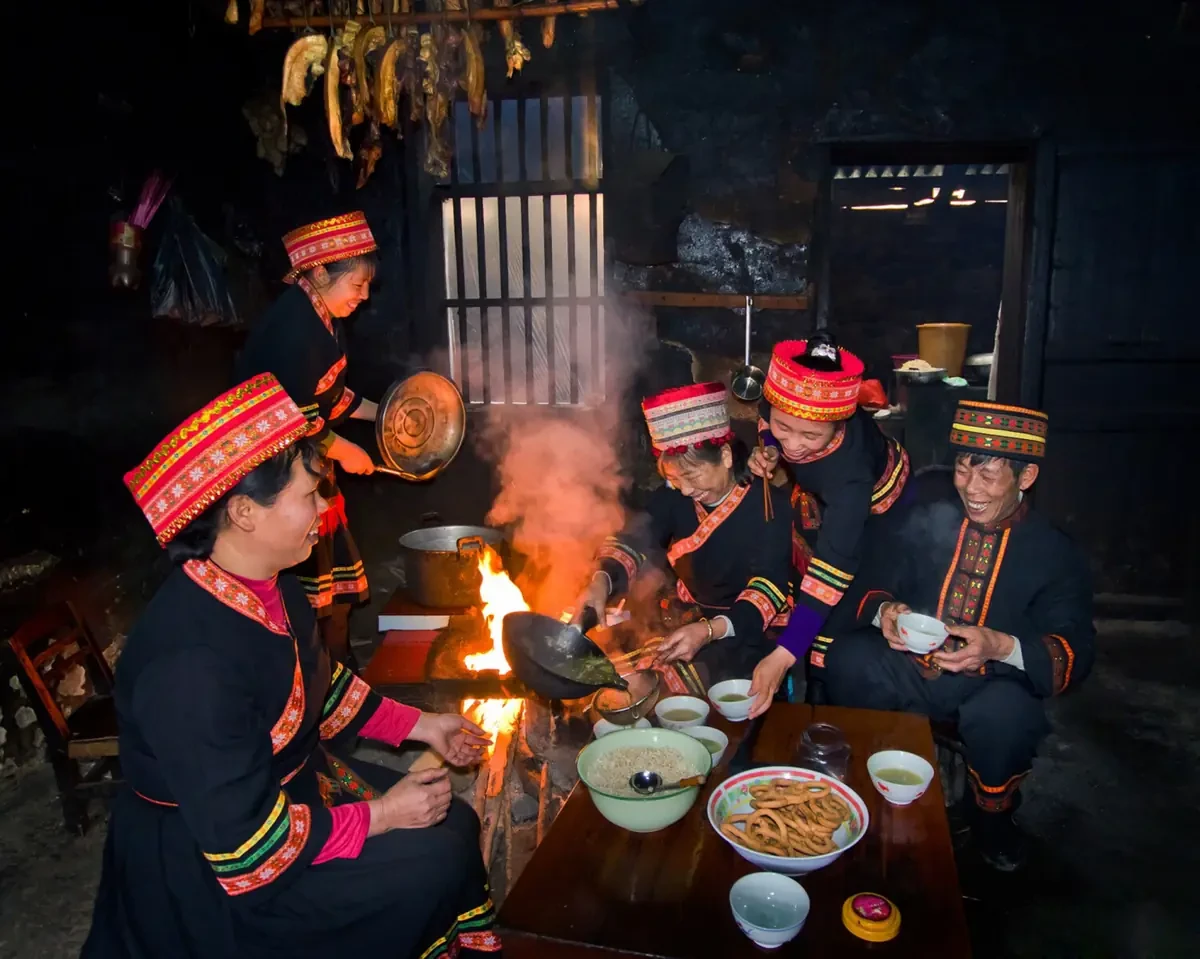
Warm laughter & bubbling Zhuang oil tea, authentic ethnic cuisine in a traditional mountain home
Back at the house, Mei prepares breakfast: oil tea (you cha), a Zhuang specialty that is less a drink and more a meal. She pounds fresh tea leaves with ginger and garlic in a heavy stone mortar, the rhythmic thud echoing through the wooden house. The paste is boiled in water, then strained, and the resulting liquid, an aromatic, slightly bitter, fiery brew, is poured into bowls over puffed rice, fried peanuts, and chopped scallions. You cup the warm bowl in your hands and sip. The ginger hits first, then the earthy tea, then the crunch of peanuts. It's unlike anything you've ever tasted, and it's exactly what your body craves after the cold dawn climb.
After breakfast, Mei hands you a small hoe and leads you to the family's nearest terrace, a small, irregular plot of flooded soil that needs weeding. You roll up your trousers and wade in. The water is cool, the mud silky beneath your bare feet. Mei shows you how to distinguish the tender rice shoots from the weeds, how to ease the invader out without disturbing the roots of the crop. It is slow, precise, back-breaking work. Within twenty minutes, your spine protests. Mei notices and laughs, a bright, genuine laugh that echoes off the terraces. "City bones," she teases, and shows you how to stretch. Then she tells you about the rice cycle: planting in spring, weeding through summer, harvest in autumn, and the frozen dormancy of winter when the terraces turn to mirrors of ice. Her life is measured not in calendar months but in the rhythms of the grain.
At noon, her husband appears, carrying sections of thick bamboo sealed with banana leaves. He props them over a fire built in a stone pit at the edge of the terrace. Inside each bamboo tube is a mixture of glutinous rice, wild mushrooms, and a few slices of that smoked pork from the kitchen beam, all seasoned with nothing more than a pinch of salt and the fragrance of the bamboo itself. He cooks them slowly, rotating the tubes over the flames until the bamboo chars and splits slightly, releasing a wisp of fragrant steam. You eat the rice with your hands, scooping the sticky grains directly from the opened bamboo, the smoky, earthy flavours mingling with the fresh mountain air. It is the simplest meal of your life, and one of the most profound.
The Road to the Border
Two days later, with mud still under your fingernails and the taste of oil tea on your tongue, you bid Mei farewell. She presses a small parcel of dried Longsheng tea into your hands and makes you promise to return. Then you descend from the terraces, catching a local bus back to Guilin, and from there, a high-speed train to Nanning. The journey is smooth and swift, the carriage bright and calm, but never dull: outside the window, the karst peaks of Guangxi give way to rolling hills, sugarcane fields, and distant blue mountains. A woman in the seat across the aisle peels a pomelo, the citrus scent filling the air, and offers you half. A young student taps through a mobile game, occasionally glancing up to smile at the shared ease of modern rail travel. The landscape rushes past at 250 kilometres per hour, yet you feel unhurried, suspended between the mountain quiet you've left and the borderlands ahead.
From Nanning, you take a local bus to Daxin County, a journey that becomes progressively more rural as the hours pass. Concrete buildings thin out, replaced by banana groves and bamboo forests. You switch to a shared van, this one with a rooster in a cage under the seat and a driver who chain-smokes and sings along to 1990s Cantopop, and finally arrive at Shuolong Town, a small settlement so close to the Vietnam border that you can smell the difference: a faint drift of coffee and fish sauce from across the invisible line.
The Waterfall and the Fence Line
You stay in a farmer's house, a simple concrete structure with a corrugated roof and a view of a distant, misty mountain wall. The farmer, a quiet man named Mr. Nong, is of Zhuang ethnicity, like Mei, but his ancestors have lived along this border for generations. At dusk, he takes you on a walk. You follow a dirt track through sugarcane fields until you reach a chain-link fence. On the other side, a group of Vietnamese women sit on plastic stools, their wares laid out on blankets: cartons of Vietnamese coffee, packets of local cigarettes, bottles of fish sauce, and stacks of fresh rice paper. They reach their hands through gaps in the wire, passing goods to Chinese buyers who pass back yuan notes. The transactions are quick, friendly, and entirely matter-of-fact. "We share this river," Mr. Nong says, pointing to the Guichun River roaring a hundred metres away. "They are our neighbours. My cousin married a woman from that village, just across."
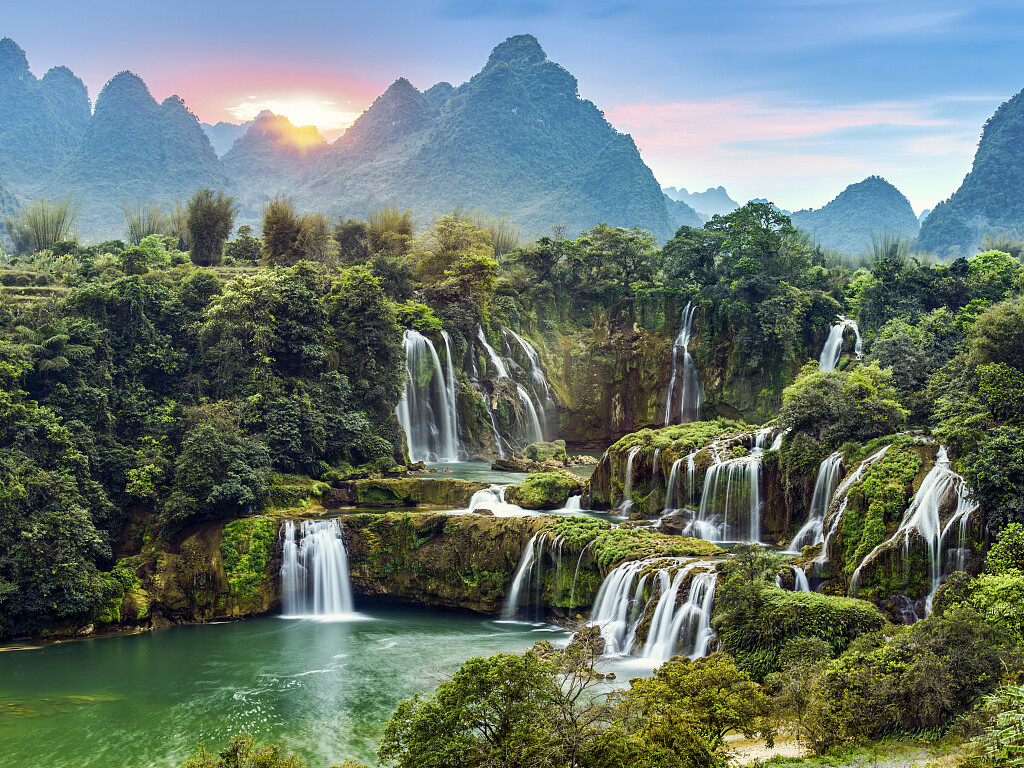
Emerald river, lush karst hills, and thunderous falls at Detian Border Waterfall
The river he points to is no ordinary stream. It plunges over a horseshoe of layered limestone, creating the Detian Waterfall, the largest transnational waterfall in Asia, shared by China and Vietnam. But you don't take the tourist boat that chugs to the base of the falls, packed with visitors in matching life jackets. Instead, Mr. Nong leads you along an unmarked trail, barely visible through the jungle, that follows the river upstream. The roar of the waterfall grows louder with each step, and the mist rises through the trees like smoke. After half an hour of scrambling over roots and rocks, you reach a small stone border marker, weathered and half-covered in moss. Carvings on its surface are faded but still legible: one side in Chinese characters, the other in Vietnamese.
On the opposite bank, a Vietnamese border guard in a green uniform spots you. He's young, perhaps twenty, with a rifle slung across his back. For a moment, you both freeze. Then, slowly, he smiles, raises his hand, and waves. You wave back. There's no tension, only the quiet recognition of two humans meeting at the seam of their nations. The waterfall thunders between you, but the gesture is gentle. Mr. Nong nods. "We have lived here together for a thousand years," he says. "The water does not care about borders."
A Feast at the Edge of the World
That evening, back in Shuolong, Mr. Nong's wife cooks dinner over a charcoal stove set up in the courtyard. The centrepiece is a clay pot of sour bamboo shoot fish, a local specialty made with fresh river carp, fermented bamboo shoots, tomato, chilli, and a handful of wild herbs plucked from the hillside. The broth is tangy, spicy, and deeply savoury, its complex sourness coming from the bamboo shoots that were pickled in the family's stone jar six months ago. Alongside it, there is stir-fried morning glory with garlic, a plate of cold poached chicken with ginger-scallion sauce, and a bowl of steaming jasmine rice. You eat under the stars, the distant rumble of Detian Falls a constant bass note, while Mr. Nong tells stories of the border: the time he helped a Vietnamese fisherman whose boat had capsized in the rainy season, the annual Tet (Lunar New Year) celebrations when families from both sides visit each other, and the rare sightings of the eastern black gibbon in the forest canopy above the falls.
After dinner, Mr. Nong brings out a bottle of homemade corn liquor. He pours two small glasses and raises his. "To the mountain," he says in heavily accented Mandarin, "and to the river." You drink. The liquor burns down your throat, warm and rough, but the toast settles deep in your chest.
The Unseen South China, Waiting for Your Footsteps
This is not a postcard. There are no gondolas, no curated photo spots, and no English audio guides. What there is, instead, is a world of real border life and real mountain life, a China that guidebooks rarely capture. It's a place where a Zhuang grandmother laughs at your weeding, where a Vietnamese guard waves across the thunder of a waterfall, and where dinner is cooked over charcoal by a family whose roots run deeper than the bamboo groves. And it's yours if you're willing to walk.
Into South China opens these hidden doors. We arrange the homestay with Mei in Longsheng, the high-speed train tickets to Nanning, the shared van to Shuolong, and the farmer's guesthouse by the border. We provide bilingual guides who can translate not just the language, but the cultural codes, why the oil tea is pounded, how to accept that offered pomelo, and what to say when you wave back at the border guard. Our deep networks across Guangxi mean we can weave this rugged, intimate journey into a larger South China adventure, taking care of every logistical step so you can focus on the mud, the bamboo rice, and the roar of the falls. Contact us to walk the terraces at dawn, to stand at the fence line, and to discover the South China that lives far from any tourist boat.
Client Review
"The Longji Rice Terraces at sunrise were the most beautiful thing I've ever seen! Golden waves cascading down mountainsides, tended by Zhuang farmers using 650-year-old techniques. Then the thunderous Detian Waterfall on the Vietnam border – absolutely spectacular. Off-the-beaten-path Guangxi at its finest!"
Trip Highlights
- ✓
Longji Rice Terraces Trekking
Dragon's Backbone hike through golden terraced fields, Zhuang village homestay, 650-year-old farming techniques, sunrise photography
- ✓
Detian Transnational Waterfall
Asia's largest cross-border waterfall, bamboo raft approach to thundering cascades, hiking trails with Vietnam views
- ✓
Ethnic Minority Encounters
Zhuang, Yao, and Miao villages, traditional markets, rice harvesting experiences, bamboo pipe wine ceremonies
- ✓
Tongling Gorge Adventure
Deep canyon exploration, ancient plant species, dramatic limestone cliffs, hidden waterfalls and caves


