If you walk through any village in rural France, you will find her: a young woman in armour, a sword in one hand, a banner in the other. Joan of Arc, the peasant girl who heard divine voices, led armies, and defied the might of the English and the corruption of the church, is stitched into the fabric of Western memory. But few foreign visitors know that China has its own Joan, a teenage farm girl who never wielded a sword, yet whose voice became a weapon just as sharp. Her name is Liu Sanjie, the “Song Fairy” of the Zhuang people, and her story is woven not into cathedrals and battlefields, but into the misty karst peaks and winding rivers of Guangxi province.
The Girl Who Sang the Truth
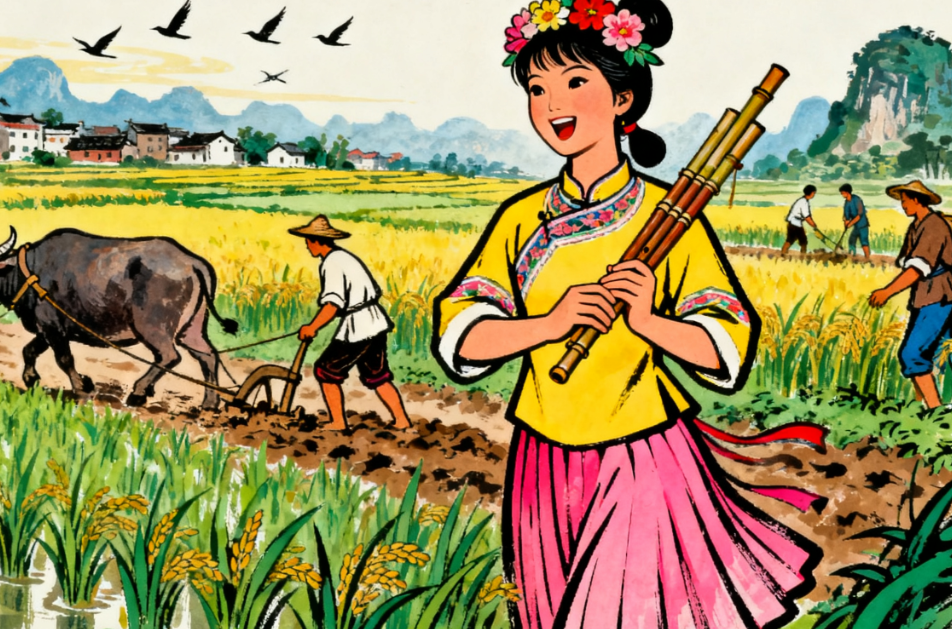
Liu Sanjie: A Legendary Songstress Who Outwitted Lords and Enchanted a Nation with Her Melodies
The legend of Liu Sanjie dates back to the Tang Dynasty, over a thousand years ago. Born into a poor farming family in what is now Yizhou, northern Guangxi, Liu Sanjie was gifted with an extraordinary voice and a genius for spontaneous verse. From a young age, she used her songs to praise the beauty of nature, the dignity of hard work, and the simple joys of ordinary people. But she also turned her melodies against the local landlords who exploited the peasants. In her most famous stories, she challenges a wealthy landowner named Mo Huairen to a singing duel. He hires three scholars, boatloads of books in tow, to defeat her in verse. One by one, Liu Sanjie out-sings them all, turning their arrogance into ridicule. Enraged and humiliated, Mo tries to silence her by force. In the climactic moment, Liu Sanjie is trapped on a cliff above the Li River. Rather than surrender, she leaps, and, according to legend, a golden carp rises from the water, lifting her into the clouds. She does not die; she becomes immortal, a voice forever echoing among the peaks.
Two Heroines, One Spirit
The parallels between Liu Sanjie and Joan of Arc are striking, and for a Western visitor, they offer a bridge into a deeply local soul. Both were teenage peasant girls with no noble blood and no formal education. Both spoke truth to power: Joan against foreign invaders and a corrupt clergy, Liu Sanjie against greedy landlords and the feudal exploitation of the rural poor. Both were celebrated not by the elite, but by ordinary villagers, who wove their stories into folk songs, festivals, and oral traditions that have lasted centuries. Both became national cultural icons, their images appearing in paintings, operas, and school textbooks.
Yet the differences illuminate something essential about the two cultures. Joan of Arc’s story is saturated with religious vision and military martyrdom; her monuments are stone statues and Gothic churches. Liu Sanjie’s story, in contrast, is entirely secular and rooted in the landscape itself. Her power comes not from God but from nature, community, and the improvisational genius of folk music. Her “cathedrals” are the limestone towers of Guilin, her “hymns” the mountain songs still sung by Zhuang villagers during the annual “San Yue San” (Third of March) festival. Joan fought with steel; Liu Sanjie fought with song. Both won a kind of immortality.
Chasing the Song Fairy Through Guangxi
To travel in Liu Sanjie’s footsteps is to step into a living folk epic. The journey begins in her reputed hometown, Yizhou, where the Xiajian River still winds past bamboo groves and the Liu Sanjie Former Residence offers a glimpse of traditional Zhuang life. Visitors can board a small boat and be serenaded by local singers who keep her style alive.
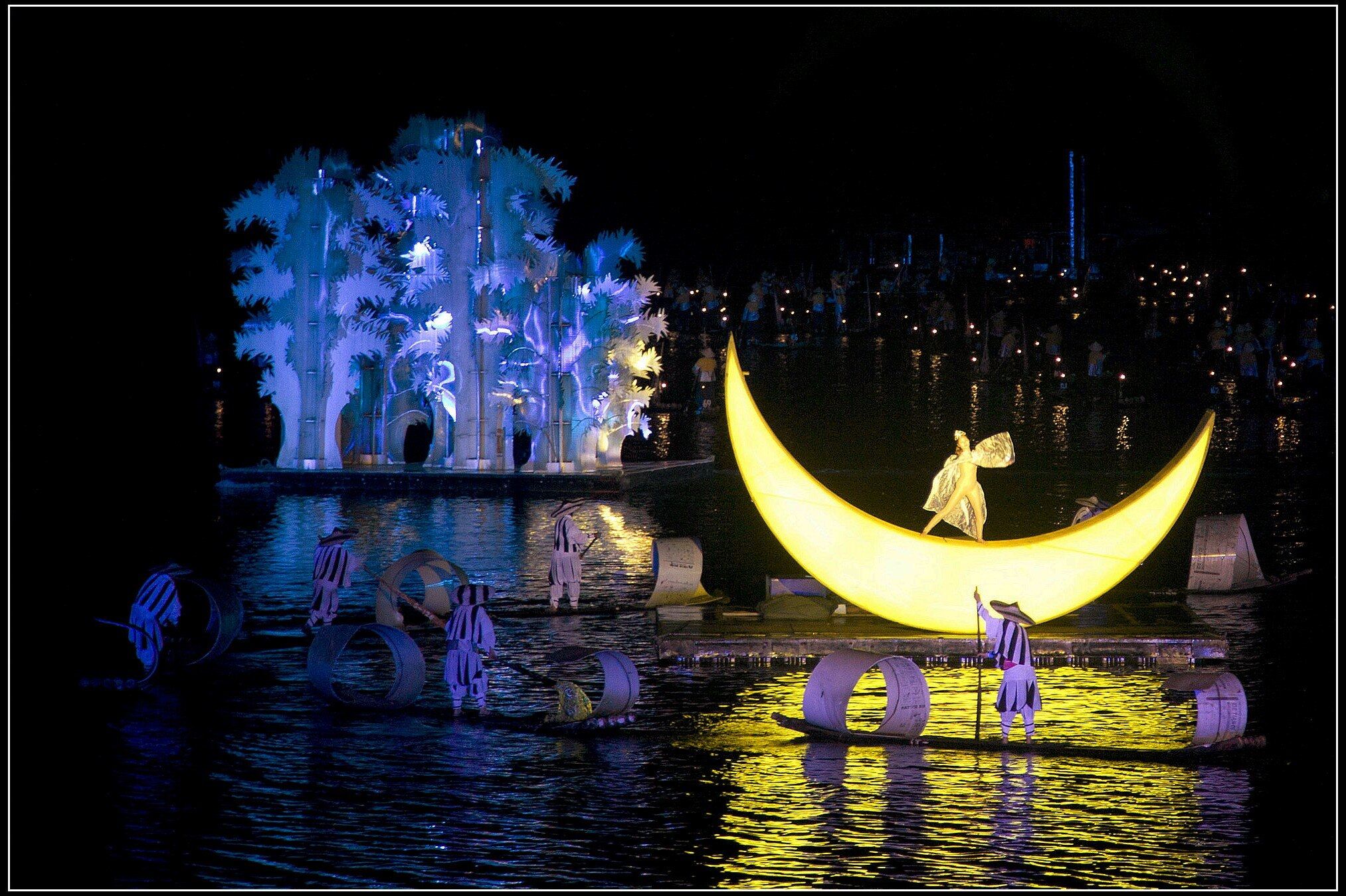
Chinese entertainers perform during a show of the large outdoor performance "Impression Sanjie Liu" on the Li River in Yangshuo County
But the most spectacular tribute is the one that turned her legend into a global spectacle: Impression Liu Sanjie (印象刘三姐) in Yangshuo. Directed by Zhang Yimou, the filmmaker behind the Beijing Olympics opening ceremony, this is not a theatre performance in any ordinary sense. The stage is a two-kilometre stretch of the Li River, framed by twelve karst peaks that are illuminated at night. The actors are mostly local farmers and fishermen who grew up singing the very songs Liu Sanjie is said to have sung. With a cast of over 600, the show blends folk music, choreography, and an almost hallucinatory use of light and water. Watching it, you begin to understand why Liu Sanjie’s story refused to stay locked in a book: the landscape itself demands to be sung about.
Beyond the show, Guangxi offers a rich Liu Sanjie trail. During the Third of March Festival (usually in April), towns across the region erupt in antiphonal singing, where you can try your own voice, no talent required, just enthusiasm. In Guilin and Yangshuo, bamboo rafts drift down the Li River past the very peaks that inspired countless classical Chinese paintings. In the Longji Rice Terraces, Zhuang and Yao villagers still cultivate the land in patterns unchanged for centuries, their songs echoing across the valleys at dusk.
Walk the Songlines with Into South China
This is deep, sensory travel that resists a quick bus-window photo. It demands local knowledge, language bridges, and a partner who can translate not just words but cultural nuances. Into South China specializes in exactly this kind of journey. Rooted in South China, covering Guangdong, Guangxi, Hainan, Hong Kong, and Macau, the team combines cross-cultural fluency with a genuine passion for local traditions. For a Liu Sanjie-inspired itinerary, Into South China can arrange a private evening at Impression Liu Sanjie with premium seating, a dawn bamboo-raft trip on the Li River with a guide who sings, a visit to a Zhuang village during the singing festival, and even a short lesson in mountain-song improvisation from local folk artists. All logistics, private transport, English-speaking guides, and accommodation from boutique river inns to five-star resorts are handled seamlessly. You arrive with curiosity and leave with songs in your memory.
Joan of Arc’s France is a pilgrimage of stone and stained glass. Liu Sanjie’s Guangxi is a pilgrimage of water, mist, and melody. Both women prove that a single, courageous voice can echo through centuries. Come hear the one who turned a river into a stage, and let Into South China guide you along the songlines.